
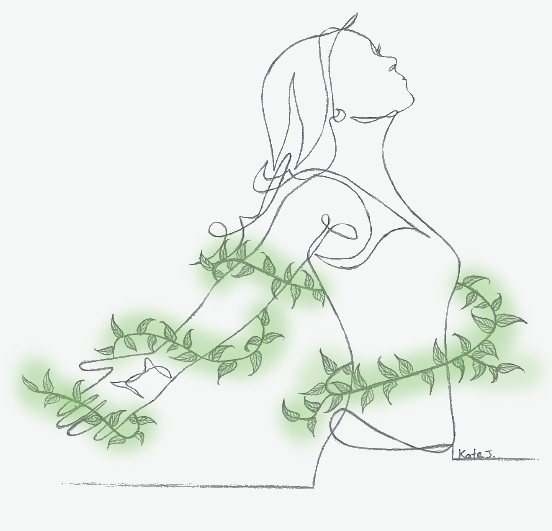

Sometimes I can sense anxiety attacks before they come. That familiar pressure starts building up in my chest, like someone dropped a brick straight onto my sternum. But sometimes the attacks come from nowhere. Laughter could be filling my lungs, and then, before I’m even aware of it, panic starts to slowly seep its way into my core. Whatever its origins, an attack still manages to make me lose control of my thoughts and sense of reason. The tremors start in my hands and methodically work their way up to my throat. My hands go numb and heavy as if two cinder blocks have been attached to my wrists. Trying to unclench my fists is nearly impossible. Regular breathing turns into ragged gasps for air. The thoughts that usually lie dormant awaken and race through my mind so quickly that my head feels like it’s full of cotton. It doesn’t matter that I’ve felt this way before; each time a panic attack takes over, it feels like I’m experiencing it for the first time all over again. The only thought that rings through my head and reverberates through my ears is I’m dying I’m dying I’m dying.
I can try to rationalize with myself, but my brain immediately activates my fight or flight mode. As far as the anxious part of my brain is concerned, I’m on the brink of death, and my only job, my only responsibility, is to make sure that I survive at all costs. But because I’m not actively in danger, all of this pent-up, fear-based energy has to manifest itself in some other way. Wringing my hands together tightly until my fingers lose feeling, clenching my jaw until it cracks, and occasionally, tugging at the same patch of skin until the blood vessel pops. My body doesn’t know how to react to the adrenaline that flows through my veins like water, so it tends to react in an extremely visceral or sometimes violent way.
This is what it all feels like—it feels so real and out of my control, almost like I’m having an out-of-body experience. My emotions are too intense, too heightened, that I experience anxiety attacks in a sort of semi-conscious haze. Oftentimes, I wonder what it looks like to other people. Can they actually see my mind going a hundred miles a minute? Do they see my heart beating out of my chest? Or see my teeth clattering together in an attempt to stop myself from shaking?
For a long time, my worst fear was someone seeing me have a panic attack. The idea of being that vulnerable in front of someone else terrified me. I didn’t want to be looked at differently by anyone, and if people saw this darker and messier side of me, then somehow my value as a human being would slowly start to diminish. There is only a small, close-knit group of people who are allowed to see me like this: it consists of my immediate family and close friends. Only they could see the cracks that marked my otherwise cool exterior.
The ironic thing about anxiety is that the fear of people seeing me panic actually contributes to my nervousness. I always felt like I had to appear as if I had everything together all of the time, and if I didn’t, then that was another thing that I had lost control of. There was a time in my life when that fear consumed me. But that’s the problem with compressing your emotions into a neat little box. Eventually, something will set you off—and it’s always the smallest thing that makes you crumble.
For me, it happened while chatting with a friend during my first year of undergrad. We were complaining about the amount of assignments and readings we had to do when my friend looked at me and said, “You know, you’ve really got your shit together. I know people who barely make it to class on time, and here you are with everything done.”
Maybe it was the fact that my friend had commented on the image of myself that I had worked so hard to portray, but when she uttered those words, I felt my throat close up. I felt moisture building up in the corner of my eyes and I so badly wanted to turn to my friend and say, “But I don’t have anything together. I’m barely keeping it together.”
But of course I couldn’t say that. Opening up would be admitting to myself that I had a problem. If I had a problem, then that meant something was wrong. Nothing was wrong. Nothing nothing nothing.
I was evidently shaken up by that revelation. I’d known there was a problem and I was too afraid to do anything about it. I couldn’t pretend like it wasn’t there any longer. It was the perfect opportunity for anxiety to fix itself upon me, to dig its gnarly talons into the crooks and crevices of my body.
For months, I struggled to stay afloat amidst the torrent of anxiety and self-doubt that relentlessly swirled around in my head. My worst fear had come to life: I had lost complete and utter control. And there were times where I did lose my composure in front of people, but I’ve come to learn that most people are a lot kinder than we give them credit for. Just because I’m hard on myself doesn’t mean that other people will be too.
In the moments when the anxiety seems to snatch the air from my lungs, I have learned to find my breath. It’s so easy to listen to that little voice in the back of your head, the one that tells you you’re not good enough—not worthy of love, not worthy enough of good friends—that you forget to breathe. It’s like holding in a deep breath that you don’t realize you’ve forgotten to let out.
Don’t don’t don’t forget to breathe.
It is in the moments that you are most afraid, the most panicked, that your breath can save you. Regardless of the many things in life that are beyond control, the one and only thing that you can always control is your breath. Your breath is your power. You must learn to wield it as a weapon.
Anxiety can be a beast—it can poison every happy thought you’ve ever had—but it can also be your friend. For most of my life, I’ve looked at my anxiety like it’s an enemy, but I’m learning to look at it as a companion. For all of the harm and misery that it has brought me, it has also given me gratitude and the ability to grow. Had I not gone through that period of my life, I wouldn’t be who I am now. It was painful and frightening, but it forced me out of my shell. I had to confront the parts of me that weren’t pretty in order to open myself up to people I’d only ever kept at a distance.
None of us really have our shit together. I take immense comfort in that thought because nobody should feel like they have to have it together all the time. Life is imperfect and messy and beautiful. There are times when life is generous to you, and it feels like you’re on top of the world. And there are times when life is cruel, and all you want to do is fold in on yourself. We are not defined by the things that make us vulnerable, just like how we’re not defined by the things that make us successful.
Our value is inherent and eternal.
Sure, there will be instances where my anxiety makes me doubt every single decision that I’ve ever made—but there are also times when my anxiety has allowed me to make friends with wonderfully smart and kind people. I’m not any less of a person because I experience panic attacks, just like how you’re no less of a human being because of your own internal struggles.
When life is intense and uncertain, the only thing you can do is remember to breathe.


Sofia Colucci completed her undergraduate degree in English at Carleton University and graduated in 2022. She now works as a high school English teacher.