I want to tell you how much your mother and I love you. Let me begin: I knew I loved her but not enough to have kids with her. You’d know by now that love is not enough for things to work out.
You came into our lives so early. I was 23 and struggling with getting the needles out of my arms when I met her.
I was on a comedown when I used Tinder to send her: You look like the type of girl I’d bring home to my mom.
Three months later we were walking onto the platform at Berri station when she looked at me, trembling and candid.
I should’ve had my period a month ago. I think it’s a baby, she said.
It was you, Chloe.
I wanted to punch a wall for this mistake. I wanted to cry and curl up and flail in a puddle of mud. The head rush flowed into a body high that ebbed up out of my stomach and into my arms and through to my face when it seemed I would become a father. I wanted to laugh and smile and pick your mom up and kiss her like it was going to be okay. I said nothing then.
The train ride I thought of my mother, who had always forewarned me of the dangers of fathering too young, too early, with the wrong girl, and how “Your life ceases to be your own.” Then, I thought of my father, who may as well have not existed.
I would have to get clean to be a good father. I would have to finish my first book and dedicate it to you. What if I ended up being a terrible father like my own? What would that make me?
We got home. She was still trembling. She charged around the room, furiously zipping and unzipping her coat with growing upset. At last she peeled it off and slammed it onto the coffee table. Its zipper panged the edge of the table and chipped the glass. She crumpled to the floor, weeping.
Just sit down and try to chill out, let’s talk about this, I said. How do you want to go about this?
Her eyes reddened. What do you mean? Go about this? What do you fucking mean by that?
The tears began to come alongside a flurry of unprofessed love for you. She had known you longer than I.
In another universe this would be my version of Hemingway’s Hills Like White Elephants.
We’d not spoken as much as a whisper of that.
Are we gonna do this then? Together? she asked. Our eyes were red and puffy and soaked with optimism.
The only way through this thing was together.
I tried getting off the stuff. She quit smoking. We moved in together. You were the common denominator. The mistake began to look like serendipity. Someone with something to live for. And that we could give it all to you.
Two months later we found out from the ultrasound that you were a girl. Your momma thought you looked like a Chloe right from the get go. She thought it was the perfect name for you. I felt it, too.
Another two months later and your mom got the news. She called to tell me you were gone. I wasn’t sure what to say. There was only silence from her side of the call.
She wept for a week straight. If I saw her sleep 8 hours in that entire stretch, it’s an overstatement. Losing you killed a part of her that having another child will never revive.
After a few weeks we realized that our relationship was anchored by an idea of you as the future. And this fantasy of playing house was over.
We’d only had six months of the idea of you. Neither of us had even the chance to hold you. There are not enough words for the sensation of having been given a dream you’d never dreamt before, only to be rudely awakened from it.
I don’t know how many times I have tried to write this story, now.
Let me start again, Chloe, you have been loved more than you’ll ever know…
Victor Vigas Alvarez wants the words to dance and sing and swing. He owns a typewriter, which is unfortunately not the most efficient way to write these days. It does tickle a nerve in him that he can’t quite elucidate with words. He’s not pretentious about it. The last few years of committing his life to writing have been an interesting and humbling introduction to the life of someone that has to put words on paper to get by. He digs it.
If your father was in the military your family could expect to move every three years. We lived at six different addresses by the time I was 18. My father’s career started at Base Borden (north of Toronto); from there, we moved to London, Ontario; then to West Germany; to Ottawa, Ontario; back to West Germany; and finally back to Base Borden.
My memories of each of our homes are distinct and clear: the rooms, the people populating them, the furnishings. I can still describe the ornaments, the dishes, the carpets, and memorable events. The living room of our clapboard house on Maitland Street with the beige, nylon upholstered sofa and matching chair, the Singer sewing machine in a place of honour in the corner, the red Naugahyde ottoman with the hidden record storage inside. At our small brick bungalow on Trafalgar Street, we had two televisions, one on top of the other—one had sound and the other had a picture.
Our homes had outdoor clotheslines for wet laundry; driveways and parking spots for our Studebakers, Opel, Fiat, and Datsun; drapes and sheers and roller blinds and shutters; Kelvinator refrigerators; RCA televisions with rabbit ears; bunk beds, trundle beds, double beds, and cribs; and chrome kitchen tables with vinyl-covered matching chairs. There was a massive wall unit that reeked of my spilled patchouli oil for 40 years that held family photo albums, crystal, and French pottery. We felt rich, luxurious, and privileged when my mother purchased faux French provincial furniture and an elegant Queen Anne chair to replace the beige nylon living room furniture. I see it all…every piece of furniture, every carpet, lamp, fork, knife, spoon, and heavy aluminum pot—each with its own story of origin.
. . .
In 1965, my father’s infantry unit, the second battalion of The Royal Canadian Regiment (RCR), based in London, Ontario was chosen as one of the next groups of soldiers to rotate to West Germany to serve as part of Canada’s NATO forces. Families would accompany the soldiers for three–year postings. I recall feelings of excitement, anticipation, and dread at the news that our family would be pulling up stakes and moving. Dark dreams about Nazis and bloodred images of swastikas occupied my ten-year-old mind for weeks. My father didn’t help my uneasy feelings as he proudly explained what his job would be: protecting the people of West Germany from the Communists in the east.
We lived in Soest, a medieval, walled town in northern West Germany. The Canadians were housed in dull, three–story apartment buildings erected in the middle of farmers‘ fields on the outskirts of the city. Within two weeks of our arrival, we were woken in the middle of the night by loud sirens mounted on the sides of the apartment buildings. The sirens blared for several seconds to make sure everyone was awake, and then a loud voice yelled, “snowball, snowball, snowball.”
This went on for several minutes. My worst nightmares were being realized: surely “snowball” was code for “Communist.” In fact, it was an exercise (to be repeated many times during our stay) meant to wake up the soldiers and have them scramble to their bases (some of which were 15 kilometres away) in preparation for an invasion that thankfully never came. My father would quickly get ready and leave the apartment for his base, leaving me wide awake in my trundle bed wondering when I’d see him again. My young mind never wrapped itself around the concept of “exercise” (when the military would practise its response to various threats), and these exercises could be deadly, as I discovered the following year when my best friend’s stepfather died while on one of these “snowball” alerts.
Moving to West Germany was one of the highlights of our family history. On arrival,my father purchased a 1956 Opel station wagon from a soldier who was on his way back to Canada as a car to hold us until he found a newer one. He paid 200 Deutsche Marks, the equivalent of $50 Canadian at the time. This temporary purchase lasted our family three years and was driven all over Europe. Every weekend our parents would hustle us into the Opel and off we would go on an adventure. My father was always in a sport coat and tie, my mother dressed to the nines with a large purse looped over her arm. Her purse contained the family bible: Arthur Frommer’s Europe on $5 A Day. By the time we went home to Canada three years later, we had visited every historical site within 200 kilometres of Soest, and we had travelled to England, Holland, Belgium, Switzerland, Austria, Italy, France, and East Germany.
We lived in the middle of the Ruhr Valley, the largest industrial area of West Germany, and were never far from the vestiges of World War II, which had ended a mere 20 years before our arrival. German ingenuity and incredible hard work had restored the cities that had been devastated by repeated Allied bombings, and evidence of this was front and center in cities such as Dortmund and Hamburg, where new buildings stood shoulder to shoulder with ancient structures. This was especially notable in the postcards my mother brought back from a visit to East and West Berlin. Soest had been undamaged; however, the nearby Mohnesee Dam, which had been a repeated target of British bombers determined to shut off the water supply of this industrial area, was a fascinating place to visit. This massive dam was the subject of the movie The Dam Busters, which we watched many times. I never had the feeling of being a “tourist” when we visited these places. Thankfully, our parents refused to take us to the remnants of the concentration camps nearby that many other Canadians visited.
Soest was a treasure trove of coolness for a 10-year-old. Left to my own devices to explore, I spent endless hours on the wall (built in 1180) surrounding the old city. Walking across the farmer’s fields, the entrance gate to the city loomed largely, and we would start running as soon as it came into view. We were allowed unlimited access and climbed in and out of ancient cannon turrets; peered out of long, narrow windows high up in the tower; and ran on the wide pedestrian walkway along the top of the wall. The wall was perhaps four or five stories high, and seemed wide enough for cars; it became our shortcut to get to the public swimming pool, the dentist’s office, and the shops in the middle of town.
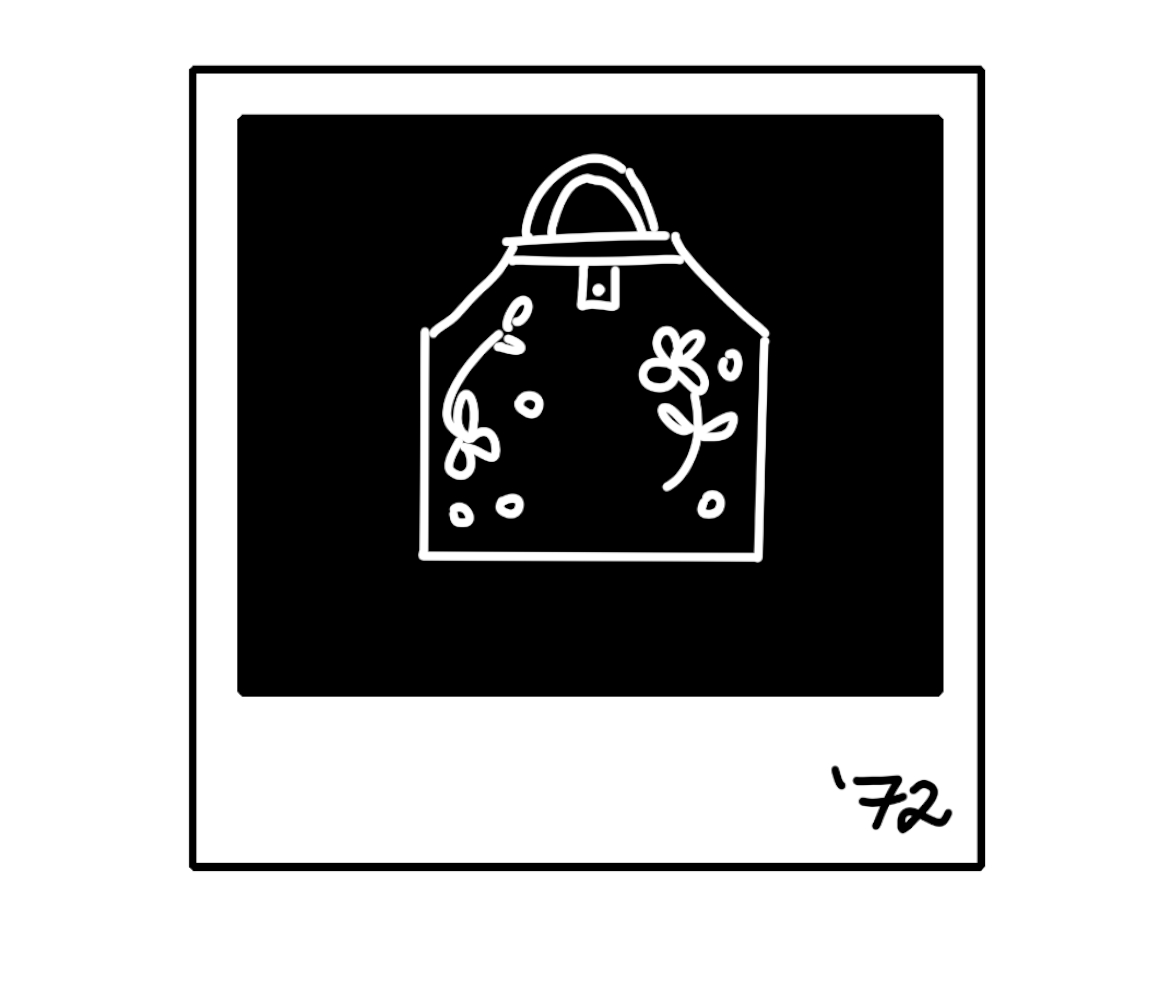
My father purchased a Super 8 movie camera and an Instamatic camera within weeks of our arrival. He became the custodian of our memories, starting a scrapbook of postcards chronicling our adventures. Our silent family movies are treasured heirlooms, despite my father’s terrible skills as a cameraman. My mother made everything happen and she was happy to stand by and observe when there were specific activities for the children, such as learning to ski at Berchtesgaden in the Bavarian Alps, or swimming like a family of otters in Lake Chiemsee after visiting a replica of Versailles built by Mad King Ludwig II. Memories of my mother standing on the side of the ski hill, knee–deep in fresh snow, with her large purse over her arm, come back to me and make me smile. She was not an athletic person at all, unlike my father, but she was ready and willing to make sure we had the opportunities. The purse, the subject of many family jokes, is ever–present in my memories of her. In a family photo taken in Salzburg, we are all dressed in salt miner outfits of white baggy pants, black shirts, round black miner caps, and the ubiquitous purse hanging on my mother’s arm. It resembled Mary Poppins’ bag, holding the necessary things like cigarettes, matches, passports, tissues, cash, Europe on $5 a Day, postcards, leftover stale buns that we hadn’t eaten at breakfast, and anything we decided we didn’t want to hold. A request of, “Mom, can you put this in your purse?” was usually followed by a long sigh, and an impatient hand thrust toward us.
My older sister and I were allowed to accompany our parents on trips without the two younger kids. On one memorable trip to England in the spring of 1967, we were treated to our first stage play (Agatha Christie’s Mousetrap), our first musical (Oliver!), Madame Tussaud’s Wax Museum (before it became a tacky tourist trap), the British Museum (where I saw the Magna Carta), and endless other sights. On a country bus trip, we visited Stratford-on-Avon, sat in a chair in Shakespeare’s house, and looked in amazement at the architectural wonder of the smooth thatched roof of Anne Hathaway’s cottage. The highlight of the trip for me was a visit to Carnaby Street, where my mother bought me fishnet stockings, an orange miniskirt, and a black turtleneck. How utterly hip and groovy was this? I was 11, the Beatles and Lulu were at the height of their popularity, and I could not wait to get home and show off my new outfit. My older sister, 14 years old, got a Burberry raincoat. To this day, the orange miniskirt and the Burberry coat are ageless symbols of two sisters’ differing fashion tastes. On our return to Soest, we repacked our suitcases and headed out for a car trip to Belgium.
Genoa, Italy, 1967: (from left to right) My father, me, my mother, older sister Linda.
There is a photo taken in Genoa, Italy of my parents, my older sister, and me in the summer of 1967. We are sitting on a stone wall in front of a massive garden with ornate flowerbeds in the shape of Christopher Columbus’ ships: the Niña, the Pinta, and the Santa María. Details like these come easily to me because the trips we took while living in Germany are etched in my brain, permanently stored with my favourite memories. The trip to Italy was legendary in my mind. I recall most details of this trip; 55 years later, and I have re-created parts of that trip with my own children in tow. Each time we visit, I regale my fellow travellers with my memories and highlights. I remain forever grateful to and in awe of my parents for putting these opportunities in place for us.
The Italy trip was by luxury coach with a busload of American military and civilians. My sister and I were the only children. My mother’s patience was endless, as my sister and I were motion sick all the time, likely caused by cigarette smoke. When we weren’t sick on the bus, we were sick on the boat to Capri, or sick because we were served green lasagna noodles (coloured green by spinach). We saw all the highlights: Milan, Pisa, Rome, Naples, Venice, Pompeii, Sorrento, Capri, and more. We were allowed to do the excursions we wanted: in Rome, my sister chose to see the opera Aida at an open–air theater; I went to a private audience with the Pope at his summer residence at Castel Gondolfo; and my parents visited the Catacombs. This was the democratic way of travelling that worked well for our family. Many of the Americans had taken my sister and me under their wing, and when we expressed a desire to see things that interested us, my parents allowed us to do so, knowing we were well–supervised.
Before my excursion to see the Pope, my mother purchased a large handful of rosaries from the vendors in St. Peter’s Square, giving them to me with strict instructions to have them blessed for my Catholic aunts. Confused about the meaning of “getting something blessed,” my fellow bus travellers assured me that it was a painless procedure and put me at the front of the group when we gathered in the garden at Castel Gondolfo. Pope Paul VI passed along the group, offering blessings. I remember wondering if he would know that I was not Catholic, was never baptized, and only went to Church when it was my father’s turn to pass the collection plate. I was determined to get those rosaries blessed and did not want to fail in my mission. My shoulders were covered with a lace shawl, borrowed from one of the women on the trip, and my curly hair was covered with a scarf, a must in those days for women. Pope Paul VI stopped in front of me, put his hand lightly on my head, said something unintelligible, and moved down the line. I kept quiet until we were back on the bus, where I complained loudly to the tour guide that the Pope hadn’t blessed my rosaries. This garnered loud guffaws from everyone, confusing me. It was patiently explained that I got better than rosaries blessed; by resting his hand on my head, I got the deluxe package, a personal Papal blessing. My complaints were passed on to my parents, giving them fodder for another family memory that has been recounted, with guffaws, many, many times since.
We left Soest in August of 1968, when I was 13, and our family moved to Ottawa. Communism was on the rise, and I was thankful that we were out of what I thought of as the danger zone, close to the East German border. Martin Luther King Jr. and Bobby Kennedy had been assassinated, Jimi Hendrix was singing about getting high, Bobby Gimby’s “Canada” was still running around in my head, and the Prague Spring had ended with Russians invading Czechoslovakia. My passport declared me Canadian, but living in West Germany and digesting international news and culture made me feel like a citizen of another world. Being back in Ottawa felt “normal” in a way that I now find hard to describe. Four years later, in July of 1972, our family was on the way back to West Germany.
Rosemarie D’Amico is a fourth year English Literature major, who has a keen interest in creative writing. Rosemarie is coming to her university education later than most and is thoroughly enjoying the experience in her retirement.
One February, Mum made me write notes on Scooby-Doo valentines. She called out “run–on sentence” and “comma splice” before ordering me to scratch my patchwork title, then other ones: Klara, and Alice, and Ashlyn, and Eddie—Dom and Nick. But us kids knew these last two, the oldest, most pungent boys, as Dominic. So, when I had to give them two valentines, they latched onto me together, crushing their jaws into my hand. Tooth–marked, I flung fractured crayons at their heads, and shrapnel spread on impact. They were an occasional terror, Dominic, sometimes bruising us kids, always sucking up to the adults.
But by spring, the twins had divided their attention between us and our teacher, Miss Mandible¹. She’d half–sit, half–lie in her desk chair, exhausted after our grammar lesson, by our disregard for her constraints. Her lethargy only encouraged the twins who, just that last winter, would help us animate our Polly Pockets. But in March they learned to deploy Diary of a Wimpy Kid hardbacks as bludgeons, seemed to favour this kind of play. Once, they even plucked Eddie from our lunch table, thwapped his head with the purple book, and crushed him face–first into the partition.
Today, the twins occupy the carpet, and race Hot Wheels into the wall so fast they crack while us kids sit criss-cross applesauce around Miss Mandible’s desk. We release mournful giggles over our half–mother’s half–death, soothe her with whispers, dust off her cloth shoes which are squishy because the world is hard on her bones. Our work continues until we grow impatient and begin to pick at her layer of nylon stocking. We want to rip through to her, but only cue unexpected snooze–slurries of words. Her phrases don’t register in our little brains, but we nearly piss ourselves in euphony, mimicking her syllables—someone actually bursts. Still savouring the finish of Miss Mandible’s codswallop in our mouths and ears, we wipe down at the sink, pat dry.
When we turn back to the desk, a knot of dust passes from one of the twins’ hands into our teacher’s lower jaw. She blinks to life with some virulent mindset, and the reeking twins sprint away, cackling like they’ve made a joke. Miss Mandible, after recovering from her slip in our pee, clenches her jaw and charges. We wail in North Korean funeral fashion as she smacks Dom’s lips and Nick’s butt like this is the UFC.
Miss Mandible punishes by splitting, like today is March’s pioneer school field trip during which our teacher was Jennifer. We had to call her Mrs. Miller in the museum’s schoolhouse despite overhearing, outside, Jennifer’s complaints about her boyfriend’s non–proposal. Still, we didn’t question Mrs. Miller’s pseudonym; the grade eights had told us disobedience in pioneer times guaranteed use of the strap, but more importantly, we were convinced calling her “Mrs.” might make her happy.
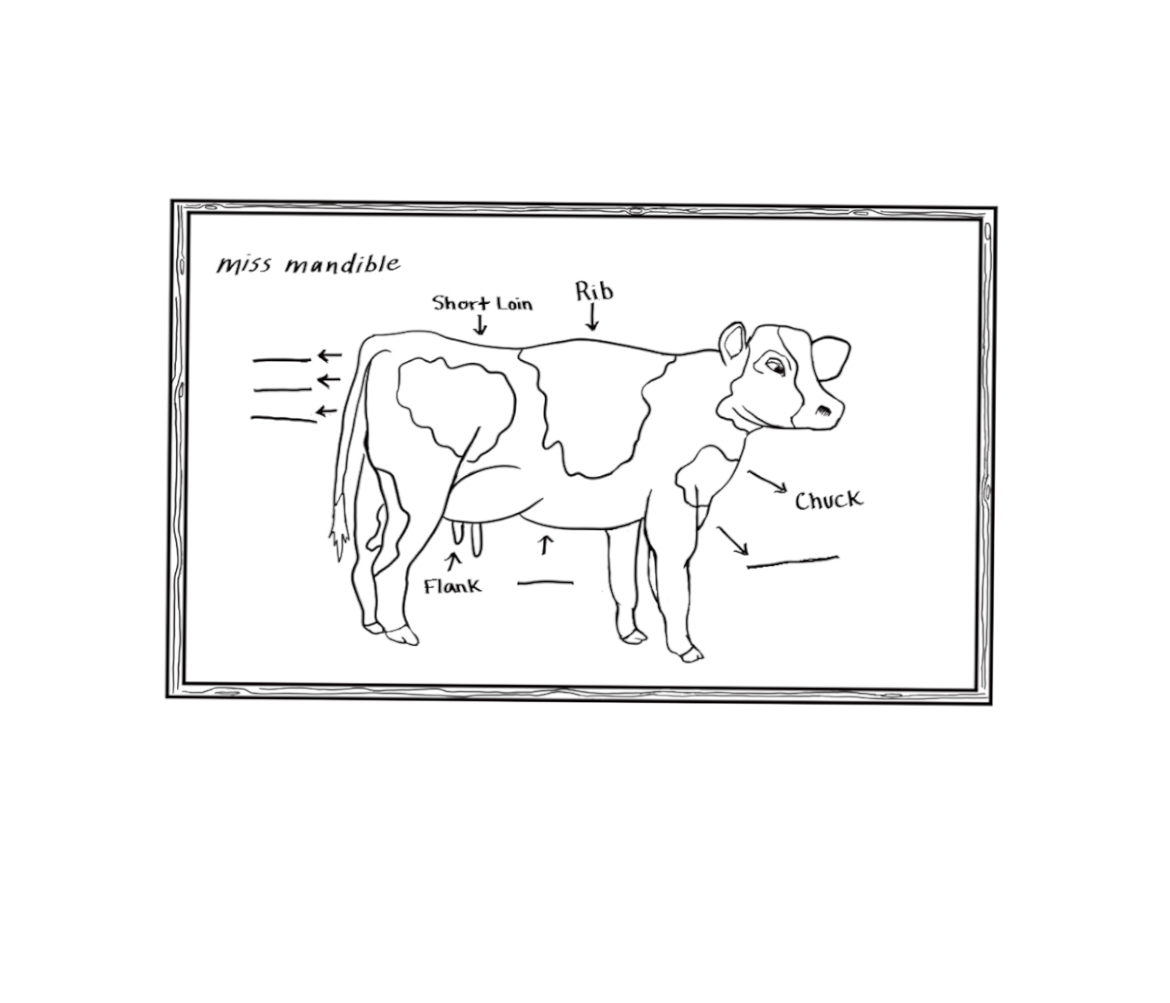
Life inside the schoolhouse was just wood and lacquer chips fracturing under our little fingers, theoretical dissection of a cow sketch on blackboard, our revolted labelling of its beef cuts. Mum told me, after her divorce, in chopped sobs and present tense, how she married Dad in that same schoolhouse. I remember my anxious righthandedness etched on the slate—Dom, dunce capped for uttering “Jennifer”—Nick’s sobs about his hatless status and separation from Dom. Us kids found our connections with Dominic akin to our bout with chicken pox, yet we got over the itching, and we cried seeing them apart. But Miss Mandible, chaperone Doug, and chaperone Suzie laughed at our grief, singled each of us out with index fingers. Each adult watched our individual embarrassments, analyzed Klara’s soggy cheeks, Eddies slack mouth, my darting eyes.
So, on the bus ride home, us kids chose to revolt, to slip Dominic some Twizzlers we’d, for preparation’s sake, practiced strapping each others’ wrists with. We peeled the strips in clumps like Scotch Tape off the roll, they were all we had to heal, sugar was the only way we could speak on the bus, the adults would destroy any written notes, they’d tear our words apart, our voices to dust. Dominic’s moping hand reached for us, flexing, only to flick our offerings to the floor and yank away. The culprit erupted a lone head out over the seatback. It was Nick, who cut us off with chaperone Doug’s commandment: “You aren’t allowed candy.”
¹ Character from Donald Barthelme’s “Me and Miss Mandible”
Nathan Erb is an undergraduate student in Carleton’s English program, concentrating in creative writing. His work has been published by the Carleton English department and FASS.
There were two main rules when in the tunnel market. First and foremost, keep your hands in your pockets and do not carry any handbags. The tunnel market infamously boasted the deftest gangs of pickpockets, coat charmers, bandits, swindlers, and vandals in all of Main Market, maybe even the state. Keep your handbags at home or in the car because these scoundrels could slip them off your hands without you noticing. Whatever belongings are necessary (wallets, car keys, phones), keep them in your pocket and make sure you can feel them in there at all times. Most people brought ghana–must–go bags, padlocked shut, to hold the things they’d buy there at the market. When you bought something new, you went into the stall or as far away from the path as possible, slipped the goods into the bag, and locked it shut again. Sometimes, people made it out of the market to find holes sliced into the bottom of their bags and all their goods missing; some wouldn’t have even noticed the change in weight. I knew of a woman whose bag was cut open, bled of its contents, filled with rocks, and then sewn shut. It was only when she had left the tunnel market and was back in her car that she noticed the crime. She hadn’t once dropped the bag from her shoulder. All this to say, none of these preventive measures are guaranteed to save you.
Whenever thieves were unlucky or lousy enough to get caught, they were burned at the square. This was always a matter of great entertainment. I remember once this boy had tried slipping a lady’s wedding ring clean off her finger but she’d caught him and started wailing, “Thief, thief oh, onye oshi, thief!” and people gathered around. The air was so tight. The reason why theft was so rampant in the tunnel market was because people were always packed in there like peas, so densely even a mosquito would not have enough space to bat its wings. Because of this, the thief could not run. People closed tightly around him like a fist as the lady held onto his tattered shirt, beating his chest with her palms. A bunch of people carried him out from the tunnel market to the square on the main street. Already the shoppers were curious, leaning with thirst.
The boy started screaming, “Please, please, I only want to feed my mother!” This was how it always went. They always wanted to feed someone, and the mob was always deaf to it. The mob loved the burnings because they saw it as retribution for all the times they had themselves been robbed and did not get justice. This boy kept screaming as the crowd whacked him with logs, bottles, stones, canes. Eventually, the men from Mechanic Village showed up with car tires. As the boy struggled, they tied his wrists and ankles, held his arms up, wore the tires on him like the beads of an abacus, doused them in petrol, and lit a match. The flames reached for the sky. He squealed, first a very shrill boyish scream—then the fire got his throat and aged his voice so he sounded like an old man shrieking. The smell of roasting flesh became lost amongst the many smells of the market’s wares. These burnings were some of the rare times the market stood still. Of course, the stillness was only an illusion. A burning was the best time for picking pockets and even as one scoundrel was being burned, others showed up to take advantage of his misfortune. I always strained to look for them whenever there was an execution. They were my version of your Tooth Fairy, my version of your Father Christmas. I watched the crowds, searching for a slow hand, for a wallet ejecting from a pocket, for goods trapdoored into a bag, but always found nothing. Only after, I saw the confused faces never too many, but just enough, patting pointlessly at their trousers and cursing at the ground.
The second rule of the tunnel market was easier to follow: no matter what you do, never pick anything up. If something fell from your hands, or from your basket, or from a market woman’s stack of goods, never bend down to pick it up. What is fallen is gone. They said that if you bent down to pick something up, an evil spirit would take you away. You would look up to find the market dark and empty. You would not be able to find your mom, your pa, or anyone else. I never heard stories of people who bent down because, as I say, this rule was easier to follow, so no one ever picked anything up. But, the claim that an evil spirit would take you away was corroborated by other stories I had heard. Like the one of a woman and her husband who were shopping at Main Market and stumbled into the tunnel. There, in the throng of people, they found a beggar. Blind, he was, and lame. He begged them for some money and they said they could not spare any. He kept begging and begging and eventually asked the woman for a kiss if she could give him nothing. The story goes that the woman agreed because she was a fool and felt bad for him. When she kissed him, she turned into a tuber of yam. Her husband and the other shoppers were outraged and demanded he turn her back, but the beggar didn’t budge. Finally, after being beaten for hours, he said that he would turn her back if the husband gave him a kiss, and when the husband did, he turned into a tuber of yam as well, and all three of them disappeared. They say the beggar was an evil spirit come to test the kindness of the market–goers.
Another one, I encountered personally. It must have been back before The Baby was born, when I was still the baby. My friend Zoba and I were in Mechanic Village because Baba wanted Zoba’s father (who was our driver) to fetch him a plumber. People were gathered around this tree they whispered housed an evil spirit. A man with a tractor was ramming into the tree, it was a really tall palm tree. Eventually the tree fell, and under the hovel of its root was a family of black cats with bright gold eyes. The cats just kept looking at us until a few women beat them to death with sticks. But then, when they took the cat corpses away, there were six white eggs there in the mud. The cats had laid the eggs, we said, so we cracked them all and threw them away. What I remember most was the smell. It smelled like smoke, but no one had burned the cats or the tree.
That Sunday, my entire family went to Main Market after church because Mama wanted to make egusi soup for Baba’s older sister who had come from London to see The Baby just born. The car had six seats in three grids. Zoba’s father was driving, with Baba in the front next to him. Mama and Aunty were in the middle row, while Zoba and I were in the back.
“You and Zoba stay in the car with The Baby,” Mama ordered, peeling The Baby from Aunty’s stubborn hands with a pacifying smile and handing It to me. I nodded and passed It to Zoba. In those days, for some reason, The Baby always made me angry whenever I saw It, or they forced me to play with It, pose with It, hold It.
“What, no!” Aunty cried, “absolutely not, that’s preposterous, let us all go into the market.”
Mama laughed disarmingly. “See, sister, it’s not advisable to take children into Main Market. Sometimes something can happen.”
“Onyinye,” Aunty whined. She always called Mama by her name, although Mama, I’m sure, was older than her. Also, because of her London accent, she made it sound not like she was saying a name, Onyinye, but like she was slurring a reprimand, Oh Ninye. “You must do away with these village girl beliefs… what, oh come now, what is that face, have I offended you? Oh Ninye, I apologize. But do you really believe a ghost will come and pluck The Baby from your hands? Bubby,” she looked at Baba, “your wife thinks a ghost will come and take The Baby away, how absurd.” Aunty laughed like a frog croaks.
Mama looked at Baba, who kept his eyes outside the window. She chuckled, sweetened her voice the way she did when she asked Baba for something, “I just think it would be fa—”
“It’s illegal in Britain to leave a child in the car, you know? In all civilized countries, it is illegal to leave children in the car. Someone would call the police on you,” she said ‘police’ like she was saying ‘please.’ “Come on, let’s bring The Baby. It is a family vacation, after all; let me spend time with my nephews, hmm. This is basically a tourist site, no?” She winked at me and I made sure not to smile back.
“I don’t want to go into the market,” I tried in defense of Mama, but then she turned to me, her eyes red and whacked me across the face hard.
“If your elders say you’re going, then you’re going,” Mama yelled. I was stunned. I hated being slapped in front of Zoba but she turned her face away when I started crying.
In this manner, it was settled, we all went into the market. Another rule for the market was to never let go of your mother’s hand, no matter how quickly she walked, or how tightly she squeezed yours. You sped up to her pace, jumping puddles and potholes; and if you had a baby, you never let go of the baby. In addition to the pickpockets, and evil spirits, there were ritualists who kidnapped children for nefarious rituals. I heard a story once of a little girl whose own mother gave her to a ritualist for blood money. They gutted the baby, and the mother became wealthy.
We walked through the Main Market. My face was stiff with dried tears and a dull pain lingering where Mama had struck me. Zoba was in her father’s arms, her small hands around his neck. Baba walked beside them, chatting quietly. Mama and I were in the front, piercing through the crowd. Aunty held The Baby in the middle. First we got melon seeds for the egusi, then onions and peppers. Cow feet, goat meat, dried fish, sweet leaf, bitter leaf, and spinach. In Mama’s other hand, she held the ghana–must–go bag, dropping the supplies into it and snapping the padlock shut around the zips.
We could not find palm oil anywhere and had been searching aimlessly for a while when suddenly, Zoba was at my side.
“Tell your Ma that you’re hungry and want to go to mama put,” she whispered.
“No, she’s angry,” I replied.
“Please, Ebube, just tell her and see what she says, hmm?”
“No, she’ll slap me again,” I said.
“Please, now, please.”
“No, Zoba, go away.”
But after Ma had given up on getting palm oil that day, she suggested we go to the mama put stall. There were many different food stalls in the market but the best ones, everyone knew, were in the tunnel market.
At the end of Main Market, the tunnel market was squeezed into the space between two large rocks. All its stalls were in caves and caverns. The path was unevenly paved with stones, cracked tiles, plates and glasses, pebbles and seashells. Above, through a thin line where the rocks touched, we could see a sliver of the sky. And it always, always, smelled like cooking food and feces.
Mama bundled her skirt between her legs and plunged down the five steps to the tunnel path in one step. With one hand around my wrist, she lifted me over the steps. Turning around, I could see Main Market well. The stalls draped in curtains and tarpaulin, umbrellas screwed onto tables and, above, the makeshift rope bridges connecting the plaza shops in the complex.
A thin dog with stringy fur withering at the doorstep of the mama put stall was being tormented by a gang of monkeys. They dangled a stewy chicken leg in front of its face, laughing in high, chirping howls while scratching at their heads and balls. The dog’s ribs were like the prongs of a rake, shivering to expand as it breathed. Like a paralyzed limb, its tongue lolled out onto the floor; whenever the monkeys dangled the chicken, it would flap like the fin of a beached fish.
The stall was carved into the side of a rock; the walls were the shiny opalesence of a pebble cracked open bearing slithering, green and blue auroras like veins so it felt like we were underwater, dining in an oyster shell. Rickety wooden benches wrapped around plastic tables. On our table, a peeling, fading sticker read, Yemi & Timothy. An image of two wedding rings connected the names. A family of women manned three large pots on open fire at the back of the cave. They all had children at their sides, fanning their flames and their faces, and babies tied to their backs. The cave was packed with people, twisting and straining, talking and laughing. Their body heat and the smoke coming from the firewood made it feel like a great gigantic beast was sitting on top of us. An old lady came and took our orders. Zoba started pulling at the fraying edge of the poster.
“So have you baptized The Baby yet, Onyinye? I forget…” Aunty began. They’d had this conversation before.
“No, not yet,” Mama responded, not looking up.
“Hmm, and why not?”
“Well, I just want to wait a while and see.”
“Ah, what’s there to see?”
Mama shrugged childishly. Aunty laughed mirthlessly, looking down at The Baby.
“My brother tells me you’re thinking of giving this one tribal marks too?”
“Yes, I am. I’m considering it,” Mama answered, glaring at Baba whose face was blank as ever.
“Onyinye, isn’t it enough that you mutilated Ebube, you want to mutilate The Baby too? Is it not enough?”
“There is no mutilation. It is a long tradition of my people to give tribal marks to members of the tribe. Long before your ‘civilization’, sister. A child does not get a name until it gets its tribal marks.”
“The tribe? They are not of your tribe, they are of Bubby’s tribe, isn’t that right, Bubby?” Baba only chuckled quietly. Encouraged, Aunty’s chest inflated, “and in our tribe, the tribe of the Lord Most High, a child gets his name when he is baptized.”
Mama turned away, towards the old lady. “Can we have water please? I beg!”
The waters came and only Mama gulped hers, opening her mouth and pouring the water down as if through a drain, condensation dripping down her palms. When the last of the water was gurgled, she palmed the bottle flat like an accordion and left it trembling like a tumbleweed on the plastic table. I thought about sipping a bottle to show support, but I was spiteful that back in the car when I’d tried to show support, she’d slapped me. Meanwhile, Aunty watched her expectantly.
“Anyway,” Mama began, “nothing is decided.” Aunty was about to respond when Baba chimed in that this was not the place to talk about this.
The food came in large stainless steel trays. Swallow wrapped in transparent cellophane and soup in plastic plates.
“You’re the one that wanted to come here,” Mama said to me after a while, “you better finish your food.” I wasn’t the one that wanted to come here. I never even asked. In response to my silence, Mama pushed the back of my head.
“Finish your food,” she gritted.
It had been a while of trying to eat when Mama called the old lady over and asked, “what kind of palm oil did you use to make this soup, Ma?”
“Just normal,” replied the old lady.
“Where did you get it from?”
“There’s a store just…” the old lady pointed.
“Take me there, I beg,” Mama said, “I pay for your time.”
The old lady nodded.
“Daddy, wallet please,” Mama asked Baba. He pulled his wallet out of his pocket and gave it to her. The old lady led Mama out of the cave and into the bustle of the tunnel market. Baba Zoba excused himself to buy something for Zoba. Whenever we went out, he always went off secretly to buy her something, but never in front of us. Zoba went with him.
“Toilet please?” Baba asked and strolled for the toilet. Not wanting to be alone with Aunty and The Baby, I took a bowl of soup and went out front. I kicked the apes away, crouched in front of the withering dog and started feeding it pieces of meat from my soup. I dropped one in front of its nose and slowly, it opened its eyes and slurped it off the ground. Then I fed more and more chunks to it. When that one was done, I went back in and took Zoba’s plate. Aunty was on her phone, The Baby on its back on the plastic table.
I fed more chunks of meat to the dog. When it had licked both plates clean, I stacked them on each other but I tripped on crooked pavement and the plates fell. Bending to pick them, I froze, realizing what I had done. I believe I stayed in that position for a while, thinking that if I didn’t open my eyes the evil spirit would not take me. Sweat bubbled on my neck, my hair felt itchy and alive like a colony of ants.
Eventually, I opened my eyes and looked through my legs. There was Aunty at the other end of the cave entrance smoking a cigarette. I shot up and turned to her. The world did not go blank, I was safe from the evil spirits. Relief like cold soothing tongues over my sore bones. Then, realization. The Baby was not in Aunty’s hands.
“Aunty, where is The Baby?” I asked.
She coughed out some smoke. “Someone’s watching him while I smoke. What? What’s that face? Jesus, you and your mother with these superstitions.”
I ran back to the table, squeezing through the crowd. Back then, the world felt to me like a cluttered kitchen table would to an ant. I elbowed, and strained through the swarm of people to our table. There was nothing there. The Baby was gone.
Olu Babs is a Nigerian-Canadian author of contemporary adult dramas. Based in Ottawa, born and raised in Nigeria, Babs combines the chilling, haunting narrative style of Canadian literature with the campfire story, mythological air of Nigerian folklore and word-of-mouth.
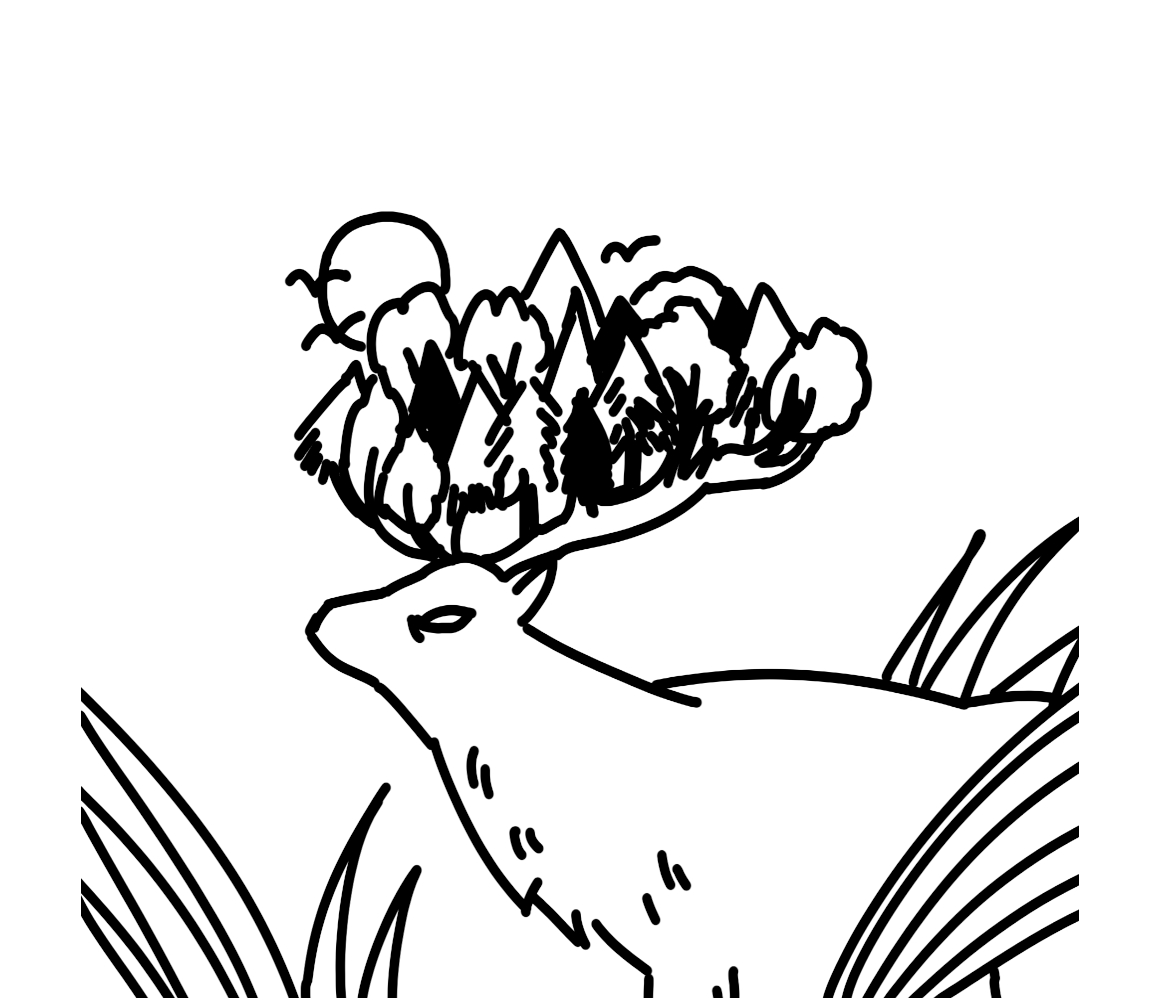
I wake crouching against rough bark. Taking a few short breaths to center myself in this new realm, echoes of memories tell me the way forward. The scents and sights of the woods are as familiar as the comfort of home, but a stillness tells me my heart is still that of an outsider. Ahead, the gaps in the lattice of branches open like pathways. They invite me forward—beckoning my surrender to the hunt—the forest baring itself to me as I’ve been taught to expect. My quarry will not be far off. Moonlit lessons on the path to my ascension have painted a picture of it in my mind’s eye: my quarry and I will be alone as two, alone as one, and then alone no longer.
We were brought to this place together, our fates woven into the woods here by blood and birthright. A stag and I, here to dance together as I have with so much prey before, but with an even greater respect for the life he will give. My mind tells me I am more challenger than hunter—here to prove that I am worth the knowledge that courses through its keeper’s veins—and patience will see me through to the end of this trial. Whispered promises have told me all the unanointed can know about this place, as hesitant as they are to imagine these sacred grounds for themselves. Now, the forest’s soul does the whispering itself, urging a name into thought: the Fever Grove. A realm that will only release me once I’ve seen this hunt through. Anticipation piles into my body, overflowing out of the tension in my legs and threatening to burst through my chest with each movement. Years of experiences cage in that chaotic energy. Before any doubt can linger, even this forest yields to me with a practiced ease.
The trained recesses of my mind take in the forest as I work my way deeper, searing in the impression of a fall canvas dulled in the twilight haze. There are no clouds in the sky that I catch occasional glimpses of between jumps, only the silvery aura of moonlight seeping through the leaves and needles where it can. In the absence of the wind, that moonlight sings to me. I know I have felt its call before, but here it is like a chorus—one harmonious blanket laid end to end over the forest—resonating to the leaps and bounds of my search through the trees. It wails in my ears, challenging the beating of my own heart, and spurs me toward the end of all that I have worked towards.
Finally, that regal magnificence rears up. The body beneath the crown of antlers moves slowly, deliberately, choosing each step through the brush as though traps lay nestled in every crooked root and tangle of moss. It is a wonder that the stag can ever fit himself through the gaps between the trees—or that with the added burden of esoteric knowledge he still manages to hold his antlers tall and steady—but his movements are still deft. My own neck burns while I watch the crown, a physical apprehension for the path that lies ahead. The wonders that the stag carries will course through my own veins by the end of this hunt. It is offered up here by the forest: speckled mushrooms thriving on the moon’s glow and waiting to be passed from mouth to mouth. Euphoric experiences in musky lodges rise in my memory, past attempts at comprehending what is to come, but never pretending to be anything but weak imitations. The stag knows it is being watched, knows its vitae is tainted with wonders it understands as innately as only the natural world can.
The time to relieve his burden is coming.
The moonlight reaches a whistling crescendo, telling me that my presence has not gone unnoticed by the masters of this place, and signaling the real chase’s beginning. I must move quickly—the stag is burdened, but hardly weakened—forcing him towards the still water that I know lies ahead. Together, we dance between the trees. Taking to the forest floor behind him, I trace the path that the stag intuits through the low growth. The chaos of his jerking movements finds a rhythm in my following step. Experience makes me unlike any other predator: unquestioning of my energy reserves, unaffected by the desperate beating of my heart. Without a need to hasten my thoughts even as I hasten my body, I keep behind my quarry.
His movement slows, growing sluggish under the weight of exhaustion. What were once darting steps are now feeble attempts at shaking my pursuit. Even with the efforts the stag has made, I know this hunt is coming to a premature end. He struggles desperately against the knowledge boiling in his blood. Nearing the center of the grove, slowing our paces in tandem, I sense the transcendent unity of that struggle. I hunt, but don’t threaten, and the stag knows. We are one, chasing the same end, and all else has fallen aside.
My penultimate ascension is a return to the tree branches above my quarry. Ahead, the mirrored surface of the forest spring freezes the stag at its edge. Through its azure–hued clarity the stag’s eyes are speckled like the night sky. Perched above, my own eyes seem to smolder in the reflection between the juts of his crown. Desire outshines anything else. It is fierce enough to give me pause even in these last moments, but that is just another hesitation that must be buried. The stag bows his head once more, as I have been taught to expect, drinking deep from the spring in the knowledge that he is at the end of his life. The weight of my knives—buried in long, slender sheaths—remind me of my true purpose here. They have been waiting patiently for the moment my hands will find their way to them. Their weight on my back threatens to pull me out of the trees, feeling as I do that their time has come. The crown, and the burden that comes with it, calls out to me through the moonlight’s song.
The descent is a blur.
I feel myself crouching in the branches, a clear path below me, and at once I am under the stag’s bared neck with one blade lodged through his flank and into his still beating heart. I can only trust in our belief that he is far beyond the point of pain, knowing simply peace as I give the final thanks and drain his life away. Our reverence for the carriers of knowledge binds us to this forest, and I know I am fortunate that the time for my ascension has coincided with the end of this venerable stag’s time here. All these assurances are carried out of my body on bated breaths. Knotting my fingers into the stag’s fur, I steady myself for the last cut and what lies beyond that.
The blood burns against my fingers. Memories of scalding tea on hazy evenings flash into my mind, but the thickness of it is like nothing I have ever known. When I put my mouth to the wound, it’s like tar pouring down my throat. I want to, need to, drink deep from this font of life. Never has my purpose been so clear. The inferno blazes in the depths of my body, threatening to consume me as it did with the stag—but it would be a cleansing consumption, a renewal. Any moment I expect my belly to burst; to feel the flames shoot out around me would be a mercy. The heat sears through my eyelids, and through the treetops the light from millions of stars slide like needles through my pores, baring my soul. I want to scream out for their merciful judgement, but my throat is snared. Even in the vividness of the imagined immolation, I can’t find the strength to loosen my grip on the stag’s neck. I gorge and gorge on the blood of life itself, submitting myself to anything and everything it has to offer me.
Finally the stag sets me free. I stumble over and down, sinking to my knees at the water’s edge. I fear that if I fall in now it would certainly boil over. I frantically quiver against limbs that won’t be compelled to action. So many of the stars have stepped down into the woods, the scattered pairs of light framed by their own sets of extravagant crowns. They are the singers, carrying the moonlight chorus that has guided me through the grove. Their eyes—those stars—bore into me. The whistling building with their movements. Constellation-like lights of the seeing stars swirl with reds, greens, blues, and violets around me—a dazzling display that serves only to further confound my fevered mind. I reach down to the earth for support, but my hands slide through mud and stone and pull me forward into the spring’s depth.
On my back in the water, I drift into darkness but do nothing to stop it. The spring is a cool panacea to my scorched body, its crystal clarity marred only by the blood lifting off my lips and now seeping down from the water’s edge. The plumes rise and fall to meet each other, entangled red ribbons—ribbons that if I could only grab onto, could be used to pull myself free. My muscles scream as I strain upwards, but as the ribbons slip through my fingers I catch only stars in my hands. The night falls over and around me, knocked free by my careless reaching. Ink swirls into the mixture of blood and water. It swallows my sight and binds my body, guiding me in my freefall.
One moment stretches out into the space of a heartbeat, then slows even further still. The forest stretches beneath me. My whole world is a mosaic of greens shifting through to the fall colours of dull flame and quiet decay, and at its center is the spring where my body lingers beneath the surface, reaching for something I can never grasp. I see now that the twilight never brightened nor faded, and yet the silver glow permeating the landscape sheds clarity throughout. Those that came before me—no longer simply the images of their orbed gaze—mill like ants around the bloodied water and the drained body of the stag. The other ascendants relieve that regal creature of his crown, preparing the antlers for their next host. Their movements follow the rhythm of my throbbing heart, spurred to frantic motion with each beat and slowing to a crawl in the aching silences in between. Devoting their intent to the vestments that will be made for me as the stag’s final gift, they pay no mind to the body floating listlessly within their reach. Its time will come again.
As I take in the ritual, silver strands of moonlight solidify their embrace on my form. The chorus of its light continues around the water below, but a fresh, smooth whisper reaches me from what seems like all around the sky. Ancient and honoured, the moon herself pulls my perception away from the woods and around the night sky. Since I joined the celestial landscape, it has become dazzlingly full with starlight, but still pale in comparison to the splendour of her lunar surface. In this light I have walked my arduous path, guided to the stag’s crown and all these sights contained within his blood. She reminds me of all this and more, caressing my mind with well-earned memories alongside those yet to be made. The flood of images, future selves walking down every path I can imagine, becomes searing, overwhelming my still frail faculties. In time with the flashing visions, the moonlight sharpens and cuts, dissecting my form before casting me back to the forest below. The moon’s scrutiny bares the darkest recesses of my soul, and I can only hope that I’ve been deemed worthy of the gifts given and those still to come. She casts me back down into my physical form, my body mournfully reaching out as though asking for more.
More of what, I could never explain.
My head is heavy beyond imagination. One of those that has come before me—having returned here to witness my ascension—must have pulled me from the pool and rested me against one of the closer trees. Every grazing blade of grass sends bolts through my open palms. My legs ache as though from days on the hunt. Never before has my body stood on such an edge, then been pushed over it only to be brought back into place, pulled apart only to be pieced back together. In the calmed water’s reflection, I see that the sky has been emptied of stars once more. Empty, save for two crimson specks. They gaze hungrily into themselves, captured in the mirror by the stag’s forest crown.
Sean B. Muncaster is a fourth-year English student, learning to explore the weird and macabre through creative writing.
The expectation that my first step on campus this fall would declaw the kindred estrangement that had latched onto me since 2020 was one I should never have set. For the second year in a row, I was late to my first class of the semester. At least the unreliability of public transportation was a familiar constant. I arrived 15 minutes into the psychology lecture and was forced to crawl over the stuffed backpacks of first-year students to find a seat in the massive auditorium filled to the brim with hundreds of faces—a stark contrast to the complete anonymity of last year, when everyone’s yawns were concealed by thick fabric that had become a second skin. I hadn’t realized just how deserted the campus had been last fall, until it had seemingly transformed into Times Square over the summer. I’d become so accustomed to desolate hallways in my senior year of high school that I’d become ignorant of its characteristic hustle and bustle. I wondered if the first-years—the first wave of students to have had a proper high school graduation in two years—could conceive that I got lost on my first day of university because orientation was online when I was their age and I was no longer familiar with the imminence of in-person classes. I wondered how I could ever be whole again after a global overturning severed my life in two, split me open, and unravelled my insides. I wondered how I could grow if all my formative memories were from a time when the world was an entirely different place—one that no longer existed. And I wondered why everyone around me seemed to believe it still did.
The Thursday before March Break of 2020 my English teacher asked our class for advice regarding whether she should cancel her family’s trip to Disney World now that “coronavirus” was becoming a household name. The replies were mixed, some echoing her concerns about being quarantined in the United States, others suggesting she go in case this were the last time in a while that she could travel outside the country. However, the prospect of our very own suburban school getting shut down over this hypothetical, distant danger was absurd to us—except for one guy in the class, who confidently claimed we wouldn’t be coming back after the March Break. We dismissed this allegation as being “too drastic,” yet that evening, my mother somberly announced all schools would be closing. The teenage prophet was nowhere to be seen on Friday.
Most of my teachers went about our last day as if it wasn’t about to become a historical date, reminding us that the flu was just as bad as this new virus. My biology teacher, who chose not to cover any new material, was the exception to this mindset. He had decided pulling out a textbook was futile because he was positive we wouldn’t see each other for at least a year. Instead, he taught us an Italian card game. It all seemed melodramatic at the time, but given we had just covered the unit about viruses before the one about animals “due to current circumstances,” I began to wonder if he was right. That evening, I booted up the PS4 I had received for Christmas, figuring that—if nothing else—I would have time to explore a fantastical land, from the comfort of my basement, while my parents were gone the grocery store for over two hours because the panic that we would soon grow numb to had only just set in. I had just turned 16 at the time. I was coming off the high of directing my first short film, sinking back into an untreated depression that I quietly knew would not be helped by isolation—but I had no clue just how much it would worsen, especially now that I would be stuck 24/7 with parents who didn’t believe a teenager could be having a quarter life crisis.
Ironically, I stopped wearing a metaphorical mask during the quarantine that lasted two weeks, then three weeks, then six months, as. I didn’t have to perform an identity for my classmates anymore. For as long as I can remember, I had been muting myself to please my friends even though I never seemed to be enough for them. In the confines of the four walls of my room, I didn’t have to pretend to have a crush on a guy I would haphazardly select from our grade to fit in with my friends who were already anxious about finding a date for prom while I had been repressing my sexuality for ages, paranoid they suspected me of lesbianism at our French Catholic school. Instead, I found solace in online communities where I could rave about my interests without being ridiculed for them in the cafeteria at lunch because I couldn’t fathom what other people thought about in their free time. Online, I didn’t have to face judgemental stares at my fidgeting and panic attacks. But it was also incredibly isolating for my only safety to be found in the phone that my parents would regularly confiscate, convinced technology was the cause of my depression. I regularly forgot the outside world existed. I pulled away from old friend groups because I had finally realized I might be better off without their diatribes, but also because they made me aware that my slew of neglected mental health problems was burdensome for them to see. I became friends with the five a.m. glow of the sky, unable to sleep because I knew that if I did I would have to wake up to yet another day of hazy disappointment.
As soon as schools reopened in September 2020, I relapsed into old habits of keeping suffocating company because it was the only constant I knew in my life. During my senior year, all my friend groups, old and new, imploded. Some quietly, and others very dramatically. I went through my first relationship and what I hoped would be my last all in the span of a week. The year I anticipated would be like a coming-of-age film went from a disaster movie to a soap opera that had no series finale in sight, despite being a dozen seasons too long. I emailed my English teacher, venting the grievances my parents discredited after I had flipped through the grainy, decade-old pictures populating my pink DSi’s photo gallery, crying over how the girl looking at me through the screen could never have predicted she wouldn’t have the opportunity to wear a prom dress like the ones she had been drawing. I wanted closure more than anything; some confirmation I could move onto the next stage of my life instead of my childhood and adulthood blurring together in a muddled, premature growth spurt.
And now, in my psychology class, I found myself steeped in jealousy for the sea of first-year students that populated the massive, foreign auditorium. I’m ashamed of the juvenile envy that knots my insides, and yet I can’t shake my resentment of the fact that they had a normal senior year, and I didn’t. We were told our sacrifices would be worth it because we would get a normal first year of university, unlike the class of 2020, though, that ended up being a lie. I still cry when I think of how they got to walk across a stage of applause to collect their diplomas, whereas I sat in my living room watching a malfunctioning PowerPoint livestream on my television. Sometimes I bite my lip so hard it bleeds when I wonder if they know how good they have it. That they are actually experiencing university. That they might actually transition from being teenagers to being adults thanks to these rituals I was denied—and yet, I am happy for them. I am bitterly happy that they are the first wave of students in two years to complete a proper transition, because all I can hope for is that they might be slightly more prepared for the challenges ahead. Without these ceremonies, it’s as if I was cryogenized at 16 years old while simultaneously being totally disconnected from that version of myself. I’m sure Freud would’ve loved me. I would never wish this disorientation on anyone.
My face mask marked me as a minority among the hundreds of uncovered faces, rendering it hard to believe there was ever a time when we would get reprimanded for standing too close to our friends because we were trying to have a conversation without constantly needing to repeat ourselves through thick fabric—but all these protocols had dissipated over the summer. This first day of school was overwhelmingly conventional, and I was left wondering why there was a gaping cavity in my stomach at all times when there were barely any imprints of this pandemic left. After chopping the hair I hid behind for 17 years, going to the university I never expected to attend, getting a driver’s license, and hitting the legal drinking age, I am virtually unrecognizable from the person I was when we were naïve enough to think quarantine would be nothing more than an extended March Break. I often lay awake in my room, which I rearranged to escape its overbearing intimacy, questioning if the last two years even happened, if there had ever been a time when my hair was long enough to collect the cobwebs of old friendships.
For two years, I expected I would be overjoyed when life finally made sense again, but I could never have predicted that after the last two hellish years, I would be craving the familiar state of limbo between real life and the alternate, sterile reality that reeked of the clinical tang of hand sanitizer. At times, I catch myself dubbing the latter a “fake life,” but I keep trying to remind myself that there really was a time when the word “mask” was connoted with Halloween and not a horror movie come to life. How do you reconcile two parts of yourself? Was I shrouded in the darkness of my own mind for too long to avoid growing sideways?
The amphitheatre reanimated itself at the professor’s dismissal, and a flurry of students barrelled down the stairs, keen to be anywhere but here. Last year, I could bolt down the sidewalk to catch the bus, but that proved problematic with the swarm of students now populating the pavement. I was less than 10 meters away from the platform when the bus left me in the dust. But it’s okay. I’ll just wait for the next one. I’ve got time.
Maya Meloche is currently completing a major in Film Studies with a minor in English. If they aren’t spending time with their cat, they’re probably watching a movie, or watching a movie with their cat. Maya’s passion for writing goes back to dictating stories for her mother to type on an old laptop in the late 2000s and writing fantastical stories concocted from the boredom of after-school programs in the suburbs. In 2019, Maya and their high school friends’ short film was screened at the DIGI 60 film festival in Ottawa. Maya aims to work as a screenwriter someday.