Category: Prose

  • Curiosity

    Curiosity

    Upon the steps of the mighty Parthenon, so stood Polias, the high priestess of the Greeks’ golden age: poised tall, with a spear in hand, exuding her wisdom to a crowd of eager Athenians.

    “Curiosity is a magnificent tool. The wise Athena favors those who strive for knowledge. For wisdom is given to the Greek man with the will to ask. However, curiosity may grow too powerful, and be used not for the sake of wisdom, but for the greed of lesser men, who grasp and thrash at that which is not theirs. Beware the fury of Athena.”

    This is the tragedy of Periagolos, the unwise.

    ***

    Will of wondrous wings wain not.
    See that vile be caught.
    Pillar, wall, knot,
    No hiding can be bought.
    Deep desires corrode and rot. 

    Council of three, glean his plea,
    class and bronze he wish to see.
    Nay be the answer.
    Spear to ear, an eager edge,
    A final thought from the dredge.
    Nay be the answer.
    Virgin young, headache stung,
    She demands his neck be wrung.
    Nay be the answer.

    Three enraged, out of luck.
    How shall justice be struck?
    The owl peers through truthful eyes,
    discern its subject’s lies.
    Tamper the heart,
    cut its strides.

    Yea be the answer.

    Back to life, he scamper.
    Gone is Periagolos the dancer.
    Once he was a ranter,
    No more does he answer.

    ***

    “What is it that lies beyond the coveting columns?” Periagolos asked his instructor, Daskalos, as they make their way to the Parthenon for the priestesses’ sermon. 

    “To that question, Periagolos, I have no answer. If I did, I would not share. The strength of the gods is not something to be tested, for it can be devastating for a simple Greek such as yourself.”

    “Why then can the priestesses, Polias, Plyntrides, and the young virgin Arrephoria enter the temple of Athena so freely, when we cannot?” 

    “Can’t you see? They have given up their worldly possessions and pleasures in which we so freely indulge. They have given their lives to the gods, so that we may hear their words of wisdom. You cannot have it two ways, or you will be split, and broken.”

    “They are not so special. Perhaps I want to speak with Athena.”

    “Be careful what you wish for, boy. I will hear no more of this nonsense. We are near the Parthenon. Release this from your mind, or may the Gods do it for you.” 

    Periagolos walked in shunned silence from his teacher. Their robes draped under the warm watch of Apollo. Sadness took him until his friend, Kakó, appeared.

    “Where are we off to?”

    Periagolos was first startled, then overjoyed to see his friend. Kakó was always sneaking out of class, indulging in the drink of Dionysus. Kakó brought with him times of pleasure and chaos.

    Periagolos and Kakó began dancing in the street at their reunion. 

    “It’s been many days, where have you been?”

    “A blur, I tell you. A blur of nights and of days that leaves me with a gift.”

    “A gift? What for?”

    “A gift for a gift, my friend. I do not quickly forget your showing me Daskalos’ wine cellar!” 

    They laughed. 

    “A chiefly find indeed. Now tell me, what will this gift be?”

    Kakó felt around his wavy robes, finally producing a rope tied in an unnatural shape. Periagolos scratched his head. 

    “I see you are lost.”

    “Indeed, tell me what it is you bring me?” 

    “A knot, a special knot”—Kakó glanced around to ensure no others would hear— “that can hide you from the Gods.”

    Periagolos gasped, “How came you by this?” 

    “A strange occurrence, I tell you. A dark region I found myself in, to unsavory folk. When a man named Dolus beckoned me over. He sold me this knot! Claiming it would shroud me from the scrying of the gods.”

    “This sounds like folly.”

    “So I thought as well! But, you would not believe all I have gotten away with while it’s been in my possession.” Kakó chuckled, thinking of his devious acts. 

    “If what you say is true, then I must have it.”

    “And what shall you do with it?”

    “I will do what no other simple Greek has done before. I will enter the Parthenon.”

    Periagolos, with the new confidence of the knot, and the agility of his youth, meandered through the crowd before the steps of the Parthenon. High priestess Polias, her hand, Plyntrides, and the virgin Arrephoria pushed the enormous door open only a crack. They stepped past the shrouding columns and began addressing the Athenians. The Priestess’ voice boomed with divine authority. She preached, relaying what wisdom Athena bestowed upon her.

    Periagolos snuck past them, staying along the outer wall. Then up he went, hugging the columns that once kept secrets from him. Now they concealed his person. The door was near, practically within reach. Answers were so close. Periagolos was lost to his great need to know. Holding his breath, and stepping quietly, Periagolos slipped in through the door unnoticed. 

    Struck instantly with a new air, Periagolos lost his own. The Parthenon seemed even larger on the inside than it was on the outside. Rich sunlight permeated the ceiling and shone upon the statue of Athena. She held an owl in her right hand and a glimmering spear in her left. The statue was made from more riches than he’d ever known. He could almost hear her thinking, see her breath. An eerie and unexplainable shock came over him. He started towards the statue in a daze. 

    Distantly, he heard the door close with an echo between the interior columns. Periagolos felt the divine presence intensify. Quickly, he dove out of sight behind a column. 

    “Athena, our great Goddess of wisdom, we have shared what you wished of us.” Polias led the way through the hall with rhythmic clangs of her spear to the marble. 

    You have done well, Polias.” Out came an enthralling voice, directly into the minds of those present, including Periagolos. He felt the immense pressure Zeus must have felt while birthing Athena from his forehead. 

    However, a great folly has been made by one Periagolos.”

    “What is it you mean, Athena?”

    A knot of deceit, and a devious mind has entered my sacred place.”

    Periagolos turned to leave but was immediately met by Polias and her spear. How she appeared there, he did not know. Periagolos fell to the marble and tried to scramble away. 

    “Who are you to think that you could enter the Parthenon of Athens?” 

    “I’m sorry, I’m—”

    “Answer me!” she bellowed. 

    “Peri-Periagolos.”

    “And why have you entered?” Pyntrides appeared behind Polias with a level and calm demeanor. 

    “I yearned to see the great halls of Athena. I needed to know what was hidden behind the columns.”

    “You knew it was forbidden, yes?”Arrephoria said. 

    Periagolos nodded. “I do apologize. Please, I beg you, let me go. I will tell none of what I saw this day. Even though it exceeds all the beauty I have known.” Periagolos could not help but steal glances at the colossal statue of Athena. 

    “Flattery will not save you now.” Polias readied her spear. 

    “Wait,” Pyntrides interrupted. “A quick death is too little a penalty. He has seen much, I say we gouge his eyes so that he may perceive nothing hereafter.”

    Periagolos trembled. 

    “Indeed,” Polias agreed. “However, what he has seen is nothing to what he has heard. The Goddess herself. Only a chosen few may hear her will. I say we slice his ears so that he may never hear again.” Polias brought the sharp edge of the spear to Periagolos’ head as he started to weep. 

    “No, no, please! You can’t. I must see and I dearly like to hear, please—” His begging and whining was to the great discomfort of Arrephoria. 

    “His tongue flaps much, my sisters. Should we not cut it loose so that he may not tell what he’s seen or heard?” Polias agreed pridefully. They reached down his throat and pulled forth his tongue. Periagolos squirmed as tears rolled down his cheeks. 

    Enough!” The will of Athena rang clear. 

    The priestesses ceased promptly. 

    “Yes, Goddess… what then shall be his punishment if not this?”

    You wish to quell a snake’s appetite to kill, you remove its teeth. The serpent will find a way to choke its victims. You try to stop a bat’s nuisance by taking their vision, louder they will become. You attempt to stop a mouse from eating from your pantry, you take its nose. Still, your rations go missing.

    Periagolos—struck stone-still—watched the massive gold statue of Athena move. In one flutter, she met him. The priestesses knelt in respect as the Goddess’ hand reached out, touching Periagolos’ forehead. 

    To level this bush, go not for the leaves, nor branches. One must dig for the very root.” The shined marble reflected the shimmering gold from Athena as it grew in divinity, light dominating the hall. 

    I, Athena, Goddess of wisdom, daughter of Zeus, hereby strip you of your curiosity.”

    ***

    Will of wondrous wings wain not
    Truth, Periagolos there got
    A deeper power, than
    previously sought.
    Now remains a
    thoughtless face
    dried with
    snot.

    ***

    Periagolos found returning to his life more difficult than entering the Parthenon. Kakó came to him with questions galore. But Periagolos no longer wished to speak with him. The topics were utterly boring. It would seem that all things grew mundane, leaving Periagolos’ mind blank. 

    Daskalos taught, but Periagolos did not listen. His friends drank, danced, and were merry. Still, Periagolos did not budge.

    As time went on, his generation of Greeks found love, settled and made legacies. Periagolos did not. He lived alone for his long and dreadful existence until his mind had gone. 

    He passed into memory, and lesson, so that all may remember the tragedy of Periagolos the unwise.

    James Brennan is a relatively new student at Carleton, however, he is not new to the creative act of writing. For about two years now, James has taken on many large—and small—projects in the realm of storytelling, including two novels that are in the editing phase and many short stories, four of which have been electronically published (https://www.story-quilt.com/artist/james-brennan). The genres of these stories vary as does James’s life. He draws inspiration from the things around him and twists them into his tales.
  • I Am Writing About God for Some Reason: Ramblings of an Atheist in Crisis

    I Am Writing About God for Some Reason: Ramblings of an Atheist in Crisis

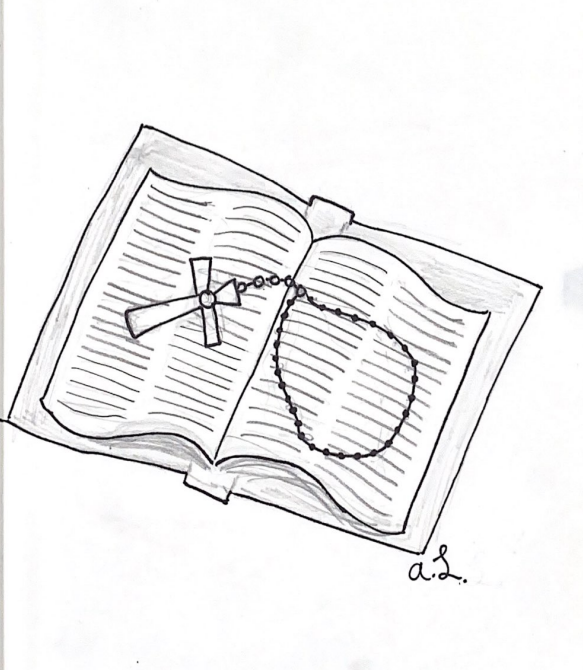
    Sometimes, I think there’s a god. Drowsy and with eyes half-lidded, I’ll make my way to the bus stop. Under the glow of a sunrise, I’ll pause to stare at the scripture posted on telephone poles, stapled on top of missing cat posters and ads for cleaning services. In the middle of the empty sidewalk, a few cars drive past, and with their headlights illuminating the dim dawn-soaked paths, I’ll read those holy pamphlets. They speak of sin, and I wonder what my life would be like if I gave in—if I let the garbled religious thoughts dictate more than shame. Can one exist without the other? Everything I do has a layer of blasphemy over it, slick and immovable. It’s that old Catholic guilt. It’s something I never earned. I went to public school, I never read the bible with pious intent, and I never clasped my hands before me with conviction. Still, I had to overcome the hesitation to gasp “Oh my god!” worrying I would upset someone I don’t believe in. Religion settles in the curves of a mold I was forced to grow into. It’s the spot on my dress I can’t scrub out. It’s there whether or not there’s a heaven or hell.

    I wonder who I would be if I read the bible and believed it. At age nine with my thumbs coated in black ink, I sat on the floor of my grandma’s bedroom beside her bookshelf with a pocket-sized bible. The font was too small, so I held a magnifying glass up to it. Maybe because of this, I saw something I wasn’t supposed to. I read about how god made light, formed Adam in his image, gave Eve one purpose, and I laughed at the thought of a talking snake. Nothing resonated with me that day. I didn’t feel enlightened or burdened with the weight of my supposed sins. But the things people would say in shows, books, and in school polluted my innate skepticism. Those virtuous preachers made promises of a pearlescent afterlife and the many ways I could be forbidden entry. They told stories of past miscreants that filled me up with an odd sense of déjà vu. They would tell me what I could and could not do, and for some reason, it stuck. I think that’s why I eat apples with a sort of reverence. The first fruit—though, that isn’t true. Earthly delights savoured, scoured, stolen. Teeth sink in, and somehow, I’m Eve again. I don’t think I could resist temptation; every time it stands before me, fresh and bloody red, I reach toward it without hesitation just to know what it felt like way back when.

    A man yells “God is dead!” on the sidewalk in front of the mall. People turn and sneer at him, teenagers giggle to one another behind closed fists, parents clasp their children’s ears and tug them closer to their side. Is it sacrilegious to just stand by and watch? If god is dead, did he ever exist at all?

    There’s a church on the corner of my street, blue-walled with a white wooden cross standing on the jut of its roof. On Sundays, I see people dressed in their finest walk down that long aisle of steps. Marble-like concrete, consecrated and holy beneath their leather and suede-clad feet. They part like the Red Sea for the priest to walk through the middle, and they bow their hatted heads as he passes. They seem comfortable in the familiar atmosphere. For me, it’s foreign territory. I have only attended church a few times, all when I was little. I would go hand in hand with my grandma, wearing a gold cross around my neck and a long summer dress. I would hold the plush leather-bound book in my hands and let my eyes trace over the words to each of the hymns they sang. I would dig my nails into the squishy cover and watch the indents disappear.

    My sister went to Catholic school. We’re half-siblings with an indecisive father and mothers of different beliefs. She would ask her at fourteen and me at ten what Hinduism was, and I would cower because I knew the word but not the meaning. She wore cross earrings and spoke sacrilege in the quiet of our room. She had a communion before she began high school, whereas I’d only ever had a baptism. During the ceremony, I sat on a pew surrounded by family, wearing a floral black dress, and spent the whole of the event trying to understand what was going on.

    Every now and then, I feel a sudden tug pull me towards the end of my block, and from the cracked pavement stairs, I’ll glance through the stained-glass windows, hear the choir sing, and imagine the gentle scent of a blown-out flame. Some deep and buried place within me craves a religious life, but I shoo away those incessant, subconscious pleas to go into the church. Still, I imagine. I would wear my Sunday best. I would tip my head before I sat in the pew. I would drink the wine and eat the bread even though I’m not allowed. I would close the curtain in that little box and confess, confess, confess.

    What if all I’m dealing with is a fear of missing out? Maybe I want god in the same way I want to attend the party everyone talks about, and relate to the songs on the radio about heartbreak, and wear that new, popular item of clothing sported by those I pass on the street. Maybe I have it right and discovered the purpose of religion (Maybe I’m young and naive and too foolish to contemplate such things).

    I have never been a religious person, but I always longed for that gentle cure, that failsafe, that salve of all that is holy and good—the antidote of faith to end the plague of questions. I wanted to feel protected by some all-powerful being, I wanted to have a fate, I wanted to end up somewhere perfect, I wanted answers. I wanted to feel connected, like the choir singers who sway as one, the uniformity of bowed heads and knees rested on those little cushioned benches behind each pew. My grandma is close with the people in her church. She feels better when she goes. She wears a cross around her neck and gets ash and holy water rubbed on her forehead. For a lot of people, religion is light, it is soft and warm—this is what I sought. I never believed in god, but a part of me wanted to.

    Recently, I’ve been reading a lot about god. Many gods, all of them, or all of the ones I know about. I read the works of cult leaders, pessimists, and priests. Nietzsche wrote about god being dead.

    Should I capitalise god? As an atheist, would it be wrong if I did? Would you care more about what I’m saying if I offered you that morsel of respect? Who wins in this scenario? Is it god himself?

    Nietzsche wrote about God being dead. He came up with characters and a plotline full of humour and tragedy and I thought about the gods of Homer and Hesiod. I wondered if the religious writings leftover today were created by people trying to make sense of their world by crafting their own forms of guidance. How do you tell the difference? Was Zarathustra real and Jesus but a myth? Could I walk up to someone and ask them why they believe, and could I get them to try and convince me? Would it be like a vegan asking why a vegetarian eats cheese? Is it just personal preference at the end of the day?

    Maybe God died and only exists in the old, the has-been, in memories. Maybe it’s leftover scraps of God that bang on the sky and cause thunder to erupt and clatter down to us. Maybe science is wrong, and the world began with Adam and Eve and that forbidden thing. Maybe if I bite the right fruit, I’ll learn the truth.

    I walk down the street, and a man yells, “GOD IS DEAD!”

    He yells, “GOD IS DEAD!” And I bow to the priest at the bottom of the steps.

    Kaelis Albota Pappert is a first-year student at Carleton working on a degree in English and a minor in Philosophy. Growing up in Ottawa meant Kaelis had access to countless libraries and supportive teachers, all of which helped to cultivate a love for the English language. Her non-fiction essay “I am Writing About God for Some Reason: Ramblings of an Atheist in Crisis” centres around her difficult relationship with organized religion. This is the first literary work Kaelis has submitted for publication.

  • I Love Potatoes!

    I Love Potatoes!

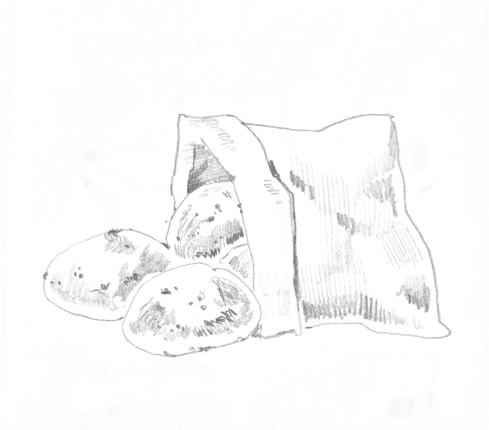
    “We love potatoes. But no one loves potatoes as much as my daughter.” My face used to burn when my mom would make that joke. But as a child, I had no shame. Rain or shine, the moment my parents drove off to work in the morning you would find me barefoot in the wet grass, running toward the garden. The wooden fence surrounding it was tall, weathered, and rough—a perfect shield for my secret. 

    The plant had an earthy smell, and when its once vibrant green leaves faded to yellow and crumbled between my fingers, I knew it was time. Using both hands I’d yank the weak stem up from the ground and give it a good shake. Like a prospector searching for gold, a thrill would run through my body whenever I uncovered potatoes dangling from the stem. Then I would stuff them into my pockets and run back inside to microwave them.

    Looking back, I’m truly horrified by this behaviour. And you may wonder why my family never caught on—well, that’s all thanks to Whiskey.

    Whiskey was a brown lab who was about as round as a barrel. He ate just about anything. No, seriously. The vacuum cleaner had nothing on him when it came to cleaning up crumbs. But if there was one thing he wouldn’t eat, it was potatoes. However, my mom didn’t know that. So, when I told her that I saw him digging them up from the garden, she stopped letting him out into the backyard. My visits to the garden stopped shortly after that.

    ***

    “We love potatoes, but no one loves potatoes as much as my daughter,” I remember my mom saying at the dinner table. God… she might as well have tossed me up onto a stage and had me dance a jig in my undies.

    “It’s only natural,” my dad interjected, offering me a comforting smile, as though that was supposed to help. “Our family is Irish after all.”

    “Our family has lived in Canada for over a hundred years.” I snatched the gravy boat, hoping to hide the mashed potatoes that I had scooped onto my plate.

    My brother’s eyes lit up, “I know why she likes potatoes.” It was as if he was about to drop the world’s greatest revelation.

    “Why’s that?” My mom asked, unaware of what he was up to. My leg bounced up and down. I could barely stand my growing unease.

    He began to laugh. “It’s because she’s built like one!” I froze. The words hit me like a slap to the face. Without another word, I pushed back my chair, stood up, and walked away from the table. It would be years before I ate potatoes again.

    ***

    “Why don’t you love potatoes anymore?” My mom asked. I was standing beside her in the kitchen, helping her with dinner. She handed me a few potatoes and asked me to peel them. Are they a fruit or a vegetable? I couldn’t be sure. It didn’t matter, though.

    I pulled on my yellow rubber gloves, stretching them all the way up to my elbows. I hated how suffocating the material felt—yet I always wore them. No matter what kind of sponge I used, the dirt never came off completely. I continued to scrub the potatoes under the tap and watched as the water turned brown and swirled down the drain. The thought of eating something so dirty made me want to throw up.

    “They’re gross,” I said flatly. The texture, the taste—it all repulsed me now. I can still see my mom’s face in my mind—her eyebrows drawing together in disappointment. She didn’t say anything, but I could tell she didn’t understand. The silence hung between us as I continued scrubbing.

    ***

    Years passed, and I haven’t lived at home since I left for college. But Thanksgiving? That was non-negotiable. Turkey, stuffing, Hawaiian rolls, who could resist? The family had also gotten a little bit bigger after my brother got married. This year, I saw that my mom had left a steaming pile of baked potatoes on the table. My brother picked one up with a fork and placed it in front of his daughter.

    “Yucky!” she said, pushing the plate away with a scrunched-up nose.

    I couldn’t help but laugh. “Have you ever tried a potato before?” She stared at me with wide eyes. I nearly forgot I was talking to a two-year-old. I reached for one of the potatoes. It burned my fingers, but that didn’t stop me from taking a big bite.

    “Delicious,” I said, giving my niece a big thumbs up. The taste was comforting, and I ate the rest of the potato in three more big bites. When I finished, I caught my mom smiling at me.

    “See? We love potatoes,” she said, giving my niece a playful wink. “But no one loves potatoes as much as my daughter.”

    Originally from Embro, Ontario, Hannah Kirwin moved to Ottawa in 2018. She loves reading, writing and gardening. Currently, she is a first-year Master of International Affairs student studying at the Norman Paterson School of International Affairs at Carleton University. Upon completing her undergraduate degree in English with a concentration in Creative Writing, she decided to submit some of her written works to Sumac Literary Magazine with the hope of getting published.

  • Moon-Drunk

    Moon-Drunk

    I was sitting on my usual armchair facing my therapist, holding a large canvas against my lap.

    “Should I show it to you now or after the session?”

    “It’s up to you.”

    “I’ll show you now, then.”

    I turned the canvas around. He gasped.

    “Oh, that’s gorgeous!”

    I held it up between us so we could both admire it. A large pale yellow moon illuminated a swirling ocean of deep blue spirals. In the distance, the lights of a tiny house on the edge of the sea could be seen. I was proud of this painting. I had been thinking about painting it for him for so long that it was wonderful to finally give it to him and have him enjoy it.

    “I wanted to thank you for all your help these last six years. I wrote something on the back.”

    I handed him the canvas, and he turned it around.

    To Matthew, October 11th, 2023

    Thank you for helping me tame the waves and tides of my mind.

    Li

    I wrote my first real poem on the last day of the hospitalization that got me diagnosed with type one bipolar disorder. It was very loose and abstract. I was trying to capture the feeling of the transformation, the incoherent yet divine feeling of becoming ravingly intoxicated on my own faulty dopamine.

    you write a saga of hope through the form-filling, the question-answering
    you chronicle your story on the white walls
    in purple crayon
    no washcloth is brave enough to wipe it all down
    no time is sufficient for everything on your to-do list; its four dimensions

    Deep down in my heart and soul, during that first pivotal manic episode, I felt that I was radiating the energy of the all-powerful moon. But that was just a delusion, quickly melted away by an intense dose of antipsychotics.

    I scribbled that poem in a hurry as it was time for me to start packing up my room. Dr. Teshima had announced earlier that day that they were discharging me, and I was so elated that I wrote down the news in my journal in giant, colourful letters. My mom brought me that journal on the day I was interned, when she realized that the staff could read anything I wrote down. Providing me with my nearly full notebook would not have been prudent.

    During that stay, I spent my days painting because writing anything elaborate was too taxing for my brain, which was bruised and battered after the shock of a psychotic episode. The damage made words difficult to recall, and I wilted from exhaustion after only twenty minutes of supervised strolling on the hospital grounds. I remembered little of what had just happened to me. All I knew was that I had done something—turned into something—unspeakably horrible and that I had nothing to do all day but paint and sleep, paint and sleep. I had gotten quite lucky regarding the ward they put me in; the children’s section was much smaller and more peaceful than the chaotic adult ward. The “classroom” was filled with books and art supplies, so I painted progressively more coherent subjects as I got more lucid.

    Although this new identity as a raving lunatic was certainly a surprise, I was never a very mentally healthy teenager. There’s a reason I’ve been in therapy for much longer than I’ve been manic-depressive. My mid-teens were spent making very precise cuts on my right forearm. I felt like I needed to fight for every inch of acceptance from the world when I realized I was nonbinary. Even as a skinny kid, I would starve myself out of hatred for my body and go weeks without feeling a single thing other than apathy.

    I mapped this out a few months ago in psychoeducation. The nurse told me to map out my life as a wavy timeline. Peaks were mania and troughs depression. I drew out waves like a heartbeat or a temperamental ocean. I wondered at the utter randomness of the thing. Who could I blame? What did it all mean? This was the question at the heart of my diagnosis. With no one to point to, I often turned inward.

    The dietician I was seeing a few months ago once told me that I don’t owe anyone my health. She believed it was completely up to me to care for myself how I saw fit. I told her I disagreed. I do owe the people I love my health. A few skipped medication doses and a few sleepless nights are all that is necessary for me to open up a black hole that devours everyone around me. When I get manic, I am not me. I become a creature of destruction. At first, it’s not so bad: I’m overly energetic and can’t shut up. But at my worst, I have religious delusions of grandeur about being a god. I will promptly empty my bank account, run into traffic, take drugs—anything goes. The last time it happened, I thought I needed to die to save the world.

    In the months following my first mania, I battled the ensuing depression by writing down everything that had happened in an ever-expanding Google doc. Every day, I would sit in my pyjamas at my computer and type out my memories of the experience of psychiatric institutionalization. I remembered more of what had happened as time went on. The resulting sixteen-thousand-word mishmash was my first attempt at creative nonfiction. I’ve tried coming back to it a few times to try and make it more polished, but I always find myself unable to get back into the freshly traumatized headspace necessary to keep working on it. It’s like trying to read a depressing book when I’m in a good mood.

    I have been fully stable for over a year now. As I’m writing this, it’s been a year, three months, two weeks, and two days since the last time I was in the hospital. I added a reverse countdown to my productivity app around the time of the one-year anniversary. Perhaps it’s unwise to keep track so precisely; I know that resetting the countdown will be soul-crushing if I ever get sick again. But these days, I let myself celebrate my well-being in whatever way I feel.

    One of the ways I do this is by trying to absorb helpful media. Sometimes, it takes the form of Sylvia Plath’s poetry. Other times, it involves reading insanely long Harry Potter fanfics (I’m talking at least three hundred thousand words). I recently got entirely absorbed into one about a werewolf. I found the descriptions of his transformations and their aftermaths deeply relatable. The lack of control, the inability to feel hopeful about the future, the agony of each full moon, the feeling like a creature, not a human—all of this resonated with me. But mainly, I related to the waking up. Feeling weak, drained, and foggy, and not having the slightest clue what I did in the last days. Needing to be nursed back to health, only for the whole cycle to happen again. Yeah, sometimes I feel like a moon-drunk monster. I guess the worst part for me is that I don’t even have the moon to blame for it. There is no regularity to my disorder. I can be a perfectly healthy young person for months on end, and then something stressful happens, and I’m back to being an invalid for the next six months.

    My body has kept score. In the three years that I’ve been bipolar, I have gained over a hundred pounds. I have shed entire closets of clothes as they slowly stopped fitting me. At first, I was convinced that it was the meds, which have more of a weight-gain side effect the younger you are when they put you on them, but now I’m not so sure. My diagnosis coincided with a lot of other changes in my life. It took a lot of therapy to make me realize that there is no reason to blame myself if it’s all guesswork anyway. I look in the mirror and have a visual reminder that things will never be the same again. But I try to think of myself in terms of softness. I am easy to hold and easy to love. I deserve the stability I now have; I’ve earned it.

    It took even more chiropractic appointments to undo the years of stress built up in my back, neck, and jaw. I used to be almost unable to concentrate on conversations with people because of how much the knot in my shoulder blade hurt. Now, I can handle all the hours of sitting with little to no pain. That’s another mark of my progress over the last year. The ocean has quieted, the tides are manageable, and the moon is having mercy.

    Li Conde is a third-year social work student with a minor in English. Their work often explores themes of mental illness and healing. It has been published in Sumac, Bywords, and flo. and won second place in the George Johnston Poetry Prize.

  • The Devil’s Deal

    The Devil’s Deal

    “Please, Miss? Can you help me?”

    The girl is quite ill; that much is obvious. Such a little thing—she couldn’t be more than seven or eight years old. Her dull brown hair hangs limply down to her shoulders, and her face is covered in dirt. Beneath the grime I can tell there’s a slight sheen on her forehead from sweat. Her cherub-like face is red, and she shakes as she stands looking up at me from the mud.

    I bend down, meeting her at eye level. “Have you got the pox? Because you’ll be needing a real doctor for that, I’m afraid.”

    She shakes her head. “No, Miss. Just the fever.”

    Normally, had she contacted a doctor, he would likely use leeches to release her bad blood. But I’m no doctor and I’ve got no leeches, so I suppose my homemade remedies will have to do.

    It’s a grey day today—the clouds conceal the sky without texture, as though someone has covered the blue with an old, soot-coloured blanket. The air is heavy with a misty fog that clings to my skin and hair. Surely this means more rain is on the way, though I must admit I’ve had enough of it these last few weeks to last me a lifetime. Things are always quite busy for me this time of year, as winter gives in to the first few rainy weeks of spring. Everything is so wet, and still rather cold. The girl in the alley is the fourth child this week I’ve been asked to treat for fever, and I would hazard a guess that she won’t be the last.

    “Wait here,” I murmur. The girl’s eyes follow me as I tread a little further down the alley.

    Mr. Clifton, with whom I trade for professional grade remedies, prefers me to use the back door to his shop. Taking the muddier back alleys may be a tad more dangerous, but I have found that it offers the most concealment from prying eyes, as these alleys simply offer back doors and storage spaces for bars and shops down the main street.

    The trade-off is quick—some herbs from my garden exchanged for a few proper remedial concoctions that I could not have made myself.

    The little girl remains precisely where I left her. Though, as I get closer, mud squelching underfoot, I notice a woman with her now. At first glance I wonder if she is the girl’s mother. She has the same dark brown hair, and she stands with her hand on the child’s shoulder. But as I draw nearer, I can see the hardness in her eyes and the stern shape of her lips. Her hand rests an inch or two from the little girl’s skin, as though she thinks it inappropriate to touch her.

    “What can I do for you?” I ask. She’s there for me—that much is obvious—but she doesn’t exactly look ill.

    Her throat constricts as she swallows, and her eyes flicker down the alley in the direction of Mr. Clifton’s. Did she see our transaction? Has she come to report me for illegal dealings?

    “This child indicated that she has been waiting for you,” she says, finally. 

    We stare at each other for a long moment, and I get the distinct sense that she is somehow sizing me up.

    The little girl releases a dry cough that breaks the silence. She takes the herbs I give her with wide eyes, staring between me and the strange woman she’s found herself sandwiched between.

    “Tell your mother to brew a strong tea,” I tell her. “And be sure to drink it all. Every drop.”

    She nods as she takes a few steps back from us. I can barely hear her mumbled words of thanks before she turns and runs down the alley, splashing mud up the back of her tattered dress.

    “Did you know her?” the woman asks.

    I decide I might as well be honest—I’m sure she’s already guessed what I’ve been up to.

    “No, I did not.”

    “Then why help?”

    “What do you suggest? That I stand by and watch a child suffer?” I don’t mean to sound so harsh, but I also don’t want to imagine it. Sitting by a child’s bed. Watching him die and doing nothing to stop it.

    She smiles then, and her face looks much less severe that way. She holds her hands up as well in a quick gesture, palms out towards me, as if in apology.

    “You practice healing, then?”

    Ah. And here it is. The reason for the disruption was not malicious, but desperate. I can hear it in her voice.

    “Mostly for the poor. Those who cannot afford a real doctor.”

    “What about the people whom the doctor has turned his back on?”

    If someone in her life is sick enough that a doctor couldn’t help, I don’t believe there’s anything more I could do for them. Still, I can’t help but picture it. Someone is suffering somewhere. There have been times, plenty of them, when I have had to walk away. Where there was nothing more that could be done. It pains me to leave a house and feel the sorrow follow me home, but I think it may hurt worse if I were to not try at all.

    “Alright,” I tell her. “Do you live around here?”

    “Yes,’ she says. There are so many emotions in the word. Relief, hope, fear, determination… in a few syllables, in her breath as she sighs, I hear it all.

    “Come with me.”

    ***

    Her house, resting on the outskirts of town, looks beautiful in the evening light. Some golden rays escape the grey clouds as we make our way up the drive, caressing the building with their light touch. Something about the air here is different. The way the breeze whispers through the trees out front, and how the white shutters sit with a child’s chalk drawings baking in the sun. It feels like a home.

    The woman, Grace, as she has told me, walks heavily up the front steps. They creak as we step up and towards the threshold. Something stops me there, though I can’t entirely describe what it is. A feeling like… like missing a step on the stairs. Like falling. Like something is wrong.

    “Oh please, do come in,” Grace beckons. She’s hanging up her shawl on a hook attached to the wood-panelled wall, and before I know it, I have done the same.

    “He’s in his room, resting. Come.”

    It’s much darker in here; no one has lit the candles yet tonight. Grace takes me through their front room and up the stairs to the second floor. There’s a smell here, something that doesn’t belong. I’ve been around illness before, of course, but I have never experienced this odour. Something sweet, but not pleasantly so. Sickly sweet. Like… rotting.

    Grace pushes his door open, and I have the strangest desire to tell her to stop. My hand grips her arm, but it’s too late. There he is, curled up in his bed, wheezing. A little boy.

    Perhaps I should have guessed this. In her desperation, I should have known. I should have recognized the desperation of a mother. But maybe I did understand, somehow. As I crossed that threshold, as she opened his door. A part of me must have known.

    Sentimentality will get me nowhere here, so I push it away. The images, feelings, of a little boy curled up in bed. A different little boy.

    The bedroom is not large. The warmth emanating from the boy’s body fills the small space, otherwise populated only by his bed and a small dresser against the back wall. A window overlooking the backyard has been left open, but the evening breeze does nothing to quell the sickly-sweet smell overpowering the room.

    The remedies I’d gathered just this morning from Mr. Clifton rattle in my bag as I put it down. The child’s forehead feels feverish under my hand, but he has no markings on his body. Nothing to suggest smallpox, or any other such illness. But his breathing is laboured, and he’s clutching his stomach, as though it pains him.

    “He has fits,” Grace whispers to me. I jump, not having heard her come up behind me.

    As his mother describes them to me, I only grow more confused. I’ve never come across an illness with such strange, unbalanced symptoms. He has an intense fever yet does not sweat or shiver. His breathing sounds laboured, yet when I ask him to cough, it is dry and without phlegm. None of his many symptoms align with any illness I have ever seen or treated.

    I begin with one of Mr. Clifton’s remedies, knowing it can do more for him than my homemade concoctions. My fingers are steady as I raise it to his lips, which, according to Grace, are dry and cracked no matter how much water he drinks. He swallows the whole bottle as though it has been delivered to him from God himself, and yet his fever will not budge. My hands begin to shake as I pull herbs from my bag, a mixture that has always worked for me before. He breathes in the fumes from this blend, meant to ease his breathing, and yet still struggles to draw breath.

    “Do you see now?” Grace asks me from where she kneels beside his head, a hand on his feverish cheek. “The doctor said there was nothing left to be done. Please, Elizabeth, please tell me this is not true. There must be something that can be done…”

    It is palpable in her voice now, no longer masked by the hope I brought to her. Fear. Mourning. I know the sound. I know it well enough that my mind shies away from it, cringing away from the void of grief Grace is opening inside herself.

    But there is a part of me that does not shy away. I can’t just let a little boy die.

    Forcing my sluggish brain into action is difficult. I have no idea what he could possibly be suffering from. Perhaps he’s in the first stages of smallpox and has yet to develop the characteristic lesions. Or maybe it’s simply some sort of flu, a kind I have yet to learn how to treat…

    The sun lowers below the horizon as I work fervently, slowly whittling down the resources I brought with me while I treat him as best I can. The moon is high by the time Grace begins to pray.

    Dear God, I place my son in your hands and ask that you restore him to health again as your humble servant…

    She continues on, and I find myself sitting back for a moment. The moonlight filters into the grim bedroom, its light bathing the boy in white. He lies there, and I watch as he shows no sign of improvement. If anything, his condition has worsened in these late hours. It must be after midnight now.

    The witching hour.

    Of course. I can’t believe I didn’t think of it until now. Of course. I had heard more and more cases recently, cases of jealous women turned witches, bidding the Devil to enact revenge on their behalf. But this young boy, how could he have wronged someone so greatly as to drive them to that extreme…

    Perhaps it wasn’t him. Perhaps it was her.

    I feel Grace watching me when I turn to her, though I can barely see her eyes in the dim light.

    “This is not a natural illness,” I tell her.

    “No,” she says. It’s a statement, not a question.

    “You knew.”

    She doesn’t answer, but her silence speaks volumes enough for me.

    “Why bring me here? Why bring me to heal a boy that cannot be cured?” I’m standing now, though I don’t remember doing so. All I know is that I need to leave—I need to get out of here now. There is evil here, and she’s led me right into it, straight into the stomach of the Devil.

    “The doctor wouldn’t help, not when he saw what had happened,” Grace gasps, tears trailing down her face. “I thought perhaps, if someone just tried…” She grabs my hand and I pull away so fast I fall into the doorframe, skinning my elbow on the rough wood. The pain brings everything sharply back into focus. The woman in front of me, so desperate to save her son she is willing to damn me in the process. And the boy behind her, wheezing in his bed. Fragile. Ignorant. Blameless.

    It’s a moment before I can speak.

    “Who did this?” My voice is rough. Aged. It is a stranger to me.

    Grace gives me a name. And I know her. She lives only a few houses down from here, not even to the end of the dirt road.

    I don’t remember leaving the house, only dimly realizing the night air is cold against my skin. My feet are too numb to feel the cold mud beneath them, but somewhere inside I keep track of the steps I take. Count the houses as they pass.

    It’s more of a shack than a house. For a moment, I can see the witch’s jealousy so clearly in my mind. I see her passing that beautiful home as she makes her way into town. I see her ridiculed for her old age, her bent back, her dirty hands, and I know that the family down the street must have been everything she wanted. Perhaps she thought that if she could not have it, then no one should.

    I knock, but there is no immediate answer. There’s a shuffling inside, and a strange noise I can’t quite place. “I know you’re in there!” I call to her. My voice sounds strong, though my hands shake at my side. It must be the cold.

    She still doesn’t answer, and all I can think of is the little boy a few houses down and his mother as she prays over his body. I push the door open myself.

    There’s a fire burning in the hearth to my left. Her house smells like dirt, perhaps a product of the leaves and soil littered about the floor in the front entryway. There’s a kitchen table to my right, herbs and meat scattered strangely on it, as though I had interrupted the witch during some sort of ritual. One of the chairs by the table has fallen to the ground, and as I follow it with my eyes, I cannot resist the urge to run.

    She lays on the floor, crumpled, even smaller in death than she was in life. But it is not her who frightens me—I have seen death before, after all. Looked it in the eyes many times. It is the man who bends over her body, the humanoid mass of shadow, that sends me reeling.

    I stumble three steps backwards into the door, whipping around and grappling for the doorknob. But as I stand there, fingers gripping the handle, I hesitate. And that one moment is all he needs.

    “A rare occurrence, indeed.”

    His voice is a hiss behind me, and I can’t bear to turn to him. It is deep and cold and merciless—the hairs on the back of my neck stand to attention. Then the Devil draws breath, and the rattling in his chest is known to me. A deep, sickly rattle. The familiarity gives me a senseless strength.

    When I turn to him, he is no longer just a shadow. He looks very much like a man.

    “It is not often that I am caught by surprise.”

    “I did not mean…” I cannot get the full sentence out; my voice shakes something awful, but he just smiles. His teeth are rotten. Such a smile is no comfort to me.

    “The witch is dead,” he says, gesturing to the body. His hand is slimy, and something that looks like scales glimmers in the firelight. Even in my fear, I understand his meaning. The boy is dead, too, for the Devil would have finished their deal before taking her soul.

    “Please,” I beg. My stomach churns as the word comes up, burning my tongue on the way out. His eyes flicker in the firelight, the flames reflected in their depths as he studies me.

    “It is not yours, as I understand.”

    But I can see mine, my boy, as he looked in his last hours. I can see his laboured breathing, the spots that covered his face burning red in the candlelight. I have watched him suffer for so long; I see it every time I close my eyes. And I feel it, too. That horrible, soul-crushing loss, etched into my heart every minute of the day.

    I think he sees this, too. Perhaps it is magic, or simply intuition, but the Devil knows my failure. He revels in it, grinning ear to ear, feeding on my suffering.

    Then he speaks.  

    “There is a way.”

    “How?” I rasp. My throat closes in on itself, tightening around the word, as if it somehow already knows how this will end.

    “I think I shall have your soul.”

    How strange. I don’t even know the boy’s name—Grace never did mention it to me. A nameless boy. Of course, it doesn’t really matter. Not in the end—in this means to an end.

    “Yes,” I breathe.

    “Take it.”

    And he makes his deal.

    ***

    Sunlight pours into the room. It is the first thing I feel—warmth—as the light falls onto my body. The wood is hard under my shoulders, but so solid that it helps to ground me in what I have done. For a moment, eyes closed there on the floor, I do not feel regret, or fear, or loss. I feel at peace.

    And then they come in. The men in their boots, shaking the ground as they enter the old witch’s hovel. They pull me up from the floor by my upper arms, yanking me away from my beam of sunlight. I can’t understand. I saved him. I saved that boy. I am not a witch. Yet, as they drag me from the house, I see her standing there. Grace and her son, rosy-cheeked and alive. And she looks at me with such disgust, such fear, I wonder if I have given in to madness.

    “Is this her, ma’am?” one of the men asks.

    She nods without hesitation.

    The sun breaches further over the horizon as they pull me away and down the road. We go past that beautiful house with its white shudders and perfect family, with the son who reminded me so much of my own.

    I hope I will see my son again.

    I hope God can forgive me.

    Please, God. Forgive me.

    Madeline Meades is an undergraduate student at Carleton University in her fourth year. She is pursuing a Bachelor of Arts degree in English with a concentration in Creative Writing and a minor in History.

  • The Peephole

    The Peephole

    I can hear the distant sputtering of the generator shutting down through the shabby wooden walls of the outhouse. The hazy yellow beam slowly backs away through the peephole as the generator releases its final gasp, plunging the outhouse into a murky purple darkness. The constricting walls loom over me, fully adorned with an eclectic collection of antique trinkets, framed paintings, and taxidermy animal heads. I rise warily and peer out through the slit in the door. Nothing. A thick, rolling overcast obstructs the moon’s pale blue glow, and without the generator’s power, the once vibrant string lights hang limply in dark branches. A howling wind breaks the stillness, rattling the rusty chain lock holding the wood door closed. A flimsy metal chain.  

    I shrink back and sit down on the wooden ledge. The stale scent of pine lingers from the tub of wood shavings brightly labelled “after-use coverings,” housed beside extra toilet paper rolls. My fingers fidget anxiously, tracing erratic circles through piles of sawdust left on the shelf. I don’t notice when the glass eyes above me begin to wander. A chill whispers on my shoulder as they shift their gaze downwards, their intrigue lingering on my form in cold distaste. Another rush of wind snaps my attention towards the door as the air whistles through the cracks in the brittle walls. I tremble, on edge, my ribcage tense as I take in timid, shallow breaths until the wind dies down again. As the air surrounding the outhouse grows quiet, I allow a shaky sigh to escape my lungs; it seems to echo in the silence, bouncing up and up between the cramped walls. My gaze tracks its path along the dark, splintered wood before it’s captured by the painted eyes of the coyote head mounted above the doorframe. Its eyes fixed on mine with a smirk. 

    ***

    “They will respond to you if you howl at them,” she said matter of factly. 

    “Who, the Coyotes?” I ask, eyes fixed on my marshmallow skewered above the campfire.  

    “Yeah,” she gestures behind her to the dark trees. “They’re back there somewhere. We used to hear them all the time after dark.” She glances at us around the fire before looking down and taking another sip of her cider.  

    “We should try it. Someone howl right now,” a playful voice chimes in, jokingly. They rise from the log and throw more fresh mint into the flames. “The bugs are starting to get annoying.” They add, swatting the air around their face dramatically before sitting back down.  

    “How many different cricket noises can you hear right now?” a quieter voice asks, addressing nobody in particular. I glance at her sprawled out on her back, lying in the grass, her eyes fixed inquisitively on the moon. We all take a moment to ponder the question. I shift my gaze up at the star-dusted sky and focus on the symphony of sounds, trying to decipher the differing chirps and chimes of crickets from the distant croaks of toads and the soft crackles of the campfire.  

    “Four,” I state plainly, returning my focus to the fire and rotating my marshmallow to reveal the golden crust forming on one side.  

    “I only hear three,” the first voice challenges with a smirk, taking the last sip of her cider. She shook the can to verify its emptiness before placing it between her palms and, with a clap of her hands, crushed it with a distinct crunch. I watched her throw the crumpled disc aside before reaching for the cooler to produce another can.  

    “I only heard three at first, too,” the third voice offers graciously. “But listen.” They hold up their hand like a conductor, ready to initiate the orchestra’s performance. We fall silent, considering the three distinct but constant chatters of crickets hiding in the brush, when, briefly, a shrill chime echoes rhythmically overtop of the chorus. “There,” they say, pointing a finger up when the sound rings again, “it’s not as frequent as the others.”  

    “I don’t understand how you guys are so good at that,” the fourth voice remarks bashfully. She sits up slowly from her place on the grass to warm her hands around the fire. “The forest is so much louder than I’m used to, it all sounds the same to me.” She trails off when a cold white flash dances across the sky from behind us. We turn instinctively to look at the rising storm clouds in the distance as the deep rumble resounds from the sky. A sharp gust of wind rushes through the clearing, strong enough to cause one of the campfire logs to tumble out of place. The fire’s warm glow dampens slightly with the loss.  

    The third voice chuckles nervously, “It’s not going to rain on us, is it?” they ask, getting up again to tend to the fallen fire.  

    “It’s not supposed to,” I say, examining my marshmallow for flaws in the dimming light before finally removing it from the stick. “I doubt those clouds will go over us.” I place my melted marshmallow on a graham cracker laced with chocolate and take a bite. “Even if they do, there is no rain in the forecast. We should be fine.”  

    “That’s good,” they nod. “We have a few more logs left, so we can probably keep this fire going a little longer if you guys are up for it.”  

    “Oh, I could stay out here all night,” the first voice snickers. “Besides, none of you have howled for the coyotes yet.”  

    ***

    The ceiling is leaking. I tilt my head back slowly, eyes glazed over; I watch the droplets protrude from each crack in the wood before collapsing to the outhouse floor in small puddles. A blank flash from outside forces itself through each tiny crack in the wood, illuminating the mounted animals’ sinister silhouettes circling the walls as if cornering their prey. A rumble growls through the vibrating air, causing the trinkets on the walls to sway and clink together with the force. It wasn’t supposed to rain. The coyote sizes me up with a snarl from its vantage point on the wall. It’s too loud now. I close my eyes. The screeching wind, the frantic tinks and clicks of swinging metal and rusted chains, the laboured creaking of the wood structure, all over the top of occasional deep roars of thunder. Four sounds, I breathe and relax the tension in my shoulders. Only four.  

    A moment of respite, but only a moment. My eyes snap open with the sound of gravel scuffling outside. The movement sounds feral, desperate. My wide eyes meet the hunting stares from above. The scuffling gets louder and louder as those glass eyes size me up. Something hits the door with a slight thud that muffles all the other sounds, and I hear whatever it is fall and settle on the gravel outside the doorframe. With my ears ringing, I stand slowly, creeping hesitantly towards the peephole. The scuffling starts again, but slower, softer, as if the movement is more controlled, a prowl. I recheck the chain lock holding the door shut and lean toward the peephole.  

    Crunch.  

    One, distinct, metal crunch.  

    Hannah Paterson is a third-year English major with a concentration in Creative Writing at Carleton. Throughout her time at school, she has had the pleasure of engaging in several creative writing classes focusing on a wide variety of genres. Over the past year, she has become increasingly interested in writing poetry and was involved in writing, editing, and designing a poetry anthology dedicated to Seamus Heaney with her Celtic Literatures class in 2024.

  • Clean Boost

    Clean Boost

    After Emily and I make our patio promise, she sends me off with her guitarist, Jimmy. He has nothing planned today and, despite his severe disdain for music journalists, has decided to let me do an interview. He takes me to a Polish steak house in the West End. 

    “They know me here,” he reassures. We sit at a small table, and the owner quietly locks the door, turning the sign to “CLOSED” for the public.

    “Impressive, I tell him. They know him, they know all his friends.

    Sebastien, another punk guitarist, sits across from Jimmy, leaving the one empty chair across from me at the table for four. An invisible guest. They talk about vintage guitar pedals and sip whiskey while I rip my napkin into a billion shredded mosaic pieces. What was there to say? All I can do is repeat back key topics like “Clean Boost,” “Inspired by Zappa,” and “Flanger.” I didn’t know anything about clean boosts, but now I want one. I want a gadget or cable connected to my imaginary pedal to bring my guitar solo forward to the crowd. I nod emphatically when they assure me I don’t want a dirty boost.

    “Sorry, Dave,” Jimmy offers. “We haven’t seen each other in a while, and this is our nerdy guitar world.”

    “That’s okay, it’s interesting. I’ll take some notes.” I reply.

    “He’s writing a piece for Emily about her and I,” Jimmy explains to Sebastien while a courteous male server clears their empty whiskey glasses, replacing them with new drinks, each with a twist of orange peel floating in amber. Piece for Emily, I scribble in the world’s most scared font, which races around the edges of my interview notebook.

    I excuse myself and go to the bathroom, wandering through the empty steakhouse past powder-blue chairs and heavy curtains. Under the mocking breath of fluorescent lights, I stare at my reflection. I’m wearing PUMA gym shorts and a PUMA hoodie, looking like Eminem’s sober coach.  I work at an athletics centre, and every adult male there dresses like a 19-year-old bodybuilder. I want to look more cerebral and intimidating. I want to glare the way anarchists glared at me when I accidentally stepped on a puppy at the Montreal Anarchist Bookfair. I asked my friend once how I knew if I could pull off a leather jacket.

    “If you have to ask…” she trailed off.  It’s the attitude, the feeling. The leather jacket finds you, like a deck of tarot cards.

    I wash my hands and head back to our own little Annual Meeting of the Guitar Nerds. The bathroom door swings closed behind me, and the paper towels and faucets rejoice in my exit, an end to my narcissist pantomime.

    I return to the table, composed and breathing steadily, suspending my own disbelief that I don’t work a minimum-wage job and am 33 in real life. Jimmy has left the table, talking to the cooks, leaning on the counter. I am scared to sit with Sebastien alone, not sure what we will talk about. There’s a moment of glassed silence where I chew ice voraciously while Sebastien squints at his phone. We have nothing in common.

    Luckily, Jimmy returns. He is trying to connect his phone to the wi-fi to play music, and pronounces it “wee fee” like Scandinavians do just to be obnoxious.

    “What do you guys want to listen to?”

    My blood freezes, brain racing through my paltry personal catalogue of music knowledge. Sebastien gestures to me as if to say your pick.

    I survey the situation. We are eating, don’t be too upbeat. We are drinking, but don’t be celebratory because the weather outside is crap. Modest Mouse’s first album? Don’t be too obtuse. Leonard Cohen? That’s too predictable. Jefferson Airplane’s Bathing at Baxters? Too abstract for the white tablecloths.

    “Put on Modest Mouse’s second album,” I blurt unconfidently.

    His eyebrows raise, approving. Sebastien says nothing.

    “Or not!” I scream. “Maybe not that!?”

    “It’s fine…” Jimmy says, “Maybe you should start drinking again.”

    The first sproing-y guitar notes enliven the steak house, turning the contrived elegance into a more raucous environment. Men could drink to this music, or men could talk to this music and not drink. It permits chaos but civility.  I am cool now, we stare into our drinks talking about the new Toronto skyscrapers and how the city is turning into the Tokyo of North America. Do you remember Honest Ed’s? Do you remember when indie meant a xylophone and a ukulele? Do you remember being 15 years old and learning an e-minor chord on the guitar?

    Jimmy already ordered for us, and the waiter brings over porcelain bowls of fluorescent purple borscht. We sip quietly. In a few minutes, we have tinted lips. I sip the earthy broth delicately. I sip the way octopuses solve puzzles. I let the nutrients enter the bloodstream under my tongue. Sebastien dabs a pierogi patiently into a pool of artisan sour cream. We talk about Canadian pop music, finally, an arena I can enter. I hold my beet-tinted spoon up to make my next point.

    “To say Avril Lavigne’s music is bad is like saying murder is bad.” I declare.

    Jimmy spits out his borscht onto the white tablecloth, and Sebastien claps his hands, and the two get red in the face, laughing hard. They are drunk. I am not drunk. Jimmy leans his hand on the table and coughs the rest of the remaining borscht driblets into the grey carpet. The waiter slips by and silently replaces their drinks. I hope Jimmy is paying. He must be paying. 

    To make men laugh uncontrollably is penultimate acceptance. You laughed at me, you like me, I made you lose supervision of your body and face for a minute. Now we can go to war together. I natter uncontrollably, scraping the spoon along the empty bowl, showing Sebastian that I can be effortless, too, as effortless as his vintage leather motorcycle jacket. I wonder if Jimmy is happy in his dating life. I wonder if Sebastien takes care of his teeth. 

    The dinner meanders aimlessly. I prop my feet on the chair beside me, sitting lengthwise and taking cute notes. I listen to them talk about insider music scene venue closures post-Covid and the opening of listening rooms. The Modest Mouse album, “The Lonesome Crowded West,” turns melancholy but hopeful, what experts call tragic optimism. This is an album for hungover showers and reheated french fries. This is an album for people who smoke at night.

    Dave Cave is a student at Carleton University and a performance artist whose work has been produced at Toronto’s Canzine Festival of Independent Artists, Charlotte Street Arts Centre (Fredericton, NB), Peterborough Comedy Festival, and Peterborough Pride Festival.

  • The White

    The White

    I don’t like it when we have to go into the bunker on the hill. Mummy says it’s to keep us safe, but it stinks like old wood and rotten fruit, and sometimes there are spiders and Samsa from the weaving house starts screaming that she feels them crawling on her skin. Then, when it’s finally time to come out, everything is so messy that we spend the next weeks having to clean and rebuild the village. But I guess that’s better than staying out in the valley where the village is. At least we won’t die in the bunker.

    We’re in the bunker now. It’s howling like evil spirits outside. Fin says it’s the souls of the dead coming to eat our faces off and they’re angry that they can’t find anyone so they’re screaming because their bellies hurt a lot. My belly hurts a lot too because I’m soooo hungry, so I understand why they’re screaming, even if I wish it wasn’t so loud. Da would say to Fin and me that there’s no such thing as face-eating souls and the sound is just the wind and rain, but Mummy only tells Fin to stop being mean. 

    Whatever it is forcing us into the bunker, we get them a ton. “Extreme weather bouts,” Da called them. He was smart, my da. He knew things about the Before time that we’re not supposed to talk about. Like how they used to have cool things called automobiles that you could ride in instead of horses and carriages, and they went faster. Boxes with fake brains that you could ask questions to, and the answers would pop out. You could speak into them and hear people from faraway places—even as far as the other side of the mountain—speak back to you.  

    Mummy says it’s fake, but Da said it was real, and sometimes they got in fights about it because the Before time is an evil thing that we shouldn’t talk about because people of the past caused us to have these “extreme weather bouts,” except Mummy and most people call them Mother Nature’s retributions. I normally didn’t listen to my parents’ fights about it, though. I know that’s bad because you have to listen to your parents, but I liked colouring more than listening to them argue.

    I’m colouring now because I always have crayons in my safe box. That’s the box I bring into the bunker when we have a retribution to hide from. It’s filled with crayons and has my favourite rock, Ned, in it. 

    My picture is not going to be very nice because the lighting is bad in the bunker. It’s only gas lamps, and we have to share them with everyone, and that’s the whole village, so a lot of people. Like, one hundred or some big number like that, plus the farm animals. I can’t count all the way yet and I don’t want to ask Fin because he’ll call me a stupid baby. But it’s a lot of people and animals in this muggy space, so there is not that much light for my colouring. 

    The picture is of our house with the wattle and daub walls and the wooden porch and the way my room and Fin’s room connect. I think maybe the house won’t be there when the retribution is over, so the picture can help us when we’re trying to rebuild it. That way, hopefully, it looks the same because it always looks a little different when we try to rebuild it, and then it takes me a long time to get used to it. 

    “What are you drawing there, Ivy?” Kayto asks me. Kayto works in the harvest fields where Mummy works, so I think he must be strong and gentle like Mummy, too. He must come home stinky and cry on the porch in the middle of the night when everyone else is supposed to be sleeping. 

    “It’s my house. In case we have to rebuild it because of Mother Nature’s retribution, I have the house plan. Da used to make the house plan, but I do it now.”

    He makes a weird face at my mummy that I think means he’s sad, except I don’t know why he would be sad, unless it’s because he’s hungry too, or because he doesn’t want to think about rebuilding his house. “I can make a house plan for you, too, but I don’t know what your house looks like, so you’d have to tell me.”

    “That’s okay. You’re a good girl, Ivy.”

    I smile, but then I see that I’ve drawn the porch wrong: it’s five steps, not six. I got confused because we had five steps and I was five years old, but then I had my birthday, so the number of steps no longer equals the number of birthdays. So now I have to redraw my plan.

    ***

    The village is mostly not destroyed, so I don’t need to use my house plan, but I keep it in my safe box just in case I need it next time. Ned will keep it company. 

    Only the far end of the village got flooded by the rain and ruined by the winds. I think the rain is Mother Nature’s tears, and I wonder why she’s sad. Fin says the wind is when she’s farting her guts out, it’s so loud and violent. Mummy yells at him for that. The far side of the village is where the weaving houses are, so they’re all crumbly and bad right now, but I think that’s better than when the drought retribution destroyed the harvest fields because everyone was crying that we wouldn’t have food when that happened, and no one is crying now. 

    Mummy tells us that we’re going to the service for Mother Nature tonight, and I groan, but not actually, only in my head, because if I groan out loud, Mummy will get mad at me. Services for Mother Nature are boring, and that’s not a good thing to think, but it’s also true because it’s just the village singing songs and throwing things like wine and dried fruits into the fire. That’s supposed to make Mother Nature happy with us and not send another retribution so quickly, except it only works like half the time because sometimes we get another one a month later. Then I have to go to another service. 

    But anyway, Mummy says we’re going to the service tonight and tells Fin and I to get clean. “I want you two looking like scrubbed potatoes, not ones just pulled from the earth,” she says. 

    Fin laughs at me. “Mummy thinks you look like a potato.”

    I don’t like Fin sometimes. I always love him, but sometimes I don’t like him, and Da told me that’s okay because we don’t always have to be happy with the people we love. 

    “Well, you look like a potato too!” I say.

    “You look like a deformed potato with those weird knobby things coming out of it, all covered in dirt and hair and mould, and no one wants to touch you.”

    “Well, you look like a… like a… like an ugly potato!”

    “Would you two please stop?” Mummy asks. She’s rubbing her fingers over her forehead. She does that when she’s sad. I take her hand and give it a squeeze because that’s what Da would do for me whenever I was sad, and it made me feel better.

    “Sorry,” we say.

    “Just go get clean. Being in the bunker makes you dirty anyway.” She strokes my cheek. “You silly potatoes.”

    We go to the well to pick up water and then lug it back, taking turns carrying the bucket because it’s super heavy. 

    The water from the well is cold, but neither of us wants to make a fire, so we suck it up and wash with this. I try to scrub my back. Da used to do that for me all the time. But he’s gone now. He died in the wildfire retribution when he was trying to save the farm animals. I was five when that happened. It was so long ago, like almost a year. Sometimes, I can’t picture his face anymore. I should make a drawing of it, just in case.

    “Do you think Mother Nature hates us?” I ask Fin.

    He shrugs. “No. She hates people from the Before, remember? They were bad to her, so now she sends retributions to remind us not to be bad to her.”

    “Yeah, but she killed Da. She must hate us.”

    “She didn’t kill Da.”

    “Her fire did.”

    “Well… okay, yeah, but that was an accident.” He starts scrubbing my back for me. “It doesn’t mean she hates us. Trust me, I learned about it in school.”

    “Okay,” I say. But I still think that she probably hates us because I don’t understand how anyone could have killed my da, even in an accident. He was too nice.

    ***

    I don’t like the days after a retribution because I always have so many chores and no time to play. I have to help pick up the garbage around the weaving houses and rebuild. I get splinters. I hate splinters. Mummy tells me I have to be more careful when I show her in the evening. She pinches my palms with her nails to get them out, and I try not to cry. 

    I wish Mummy was cleaning up with me and not in the harvest fields because then maybe she’d sing songs with me while we work, or play I Spy, or help me with my numbers. So, I choose a loom weight that’s broken and name it Lucy and she keeps me company while I work instead. She’s still not as good as Mummy, but she’s better than nothing.

    At night, I have some free time before I go to bed, so I always colour. I’m working on a drawing now that has my da.

    “Do you like it, Lucy?” I whisper, showing my loom weight the picture. 

    “Yes, it’s a very good picture,” she answers. “You’re so talented.”

    “Thank you. I drew all the drawings in my room.” I show her my walls, filled with pictures. There are some of my family, and some of the cows and chickens, and some of the mountains. 

    “Wow. That’s a lot of art. I bet everyone loves it.”

    “Yes. My da really loved it too. I drew him lots of pictures. But he’s dead now, so you won’t get to meet him.”

    “That’s too bad.”

    “Ivy!” Fin shouts from his room, which is only separated from mine with a small curtain. “Stop making your rock talk! It’s so stupid and annoying.”

    Actually, Lucy’s a loom weight, but I just say, “Sorry,” and  place Lucy on the pillow next to me and pat her head. “Goodnight, Lucy.” Then, to the picture I am drawing of my da: “Goodnight, Da.” I give him a kiss, then go to sleep.

    ***

    The weather has been strange, and everyone is scared because they think another retribution is coming. Mummy tells me everything is fine when I ask her about it, but everyone is always staring at the sky and it’s super quiet around the village. It has only been two weeks since the last retribution, and no one is ready to face another one so soon. 

    The weird thing is that it’s cold. It’s never cold in the village. It kind of feels nice compared to the boiling-hot weather we always get, but it probably means a retribution is coming.

    I wonder what the next retribution will be. A flood? A drought? A drought that leads to a fire? I hate fires.

    “Ivy, come help me make dinner!”

    I come out of my room to help Mummy. She’s making soup. 

    “Fetch Mummy some of those herbs, will you?” She points to the table, so I pick them up and drop them in the pot. 

    “The weather is funny.”

    She smiles thinly. “Yes, it is, isn’t it? That’s okay. Everything is fine.”

    “I drew another picture.”

    “What did you draw, dear?”

    I run to my room to pick it up, then show her the masterpiece I have been working on. 

    “That’s lovely. What’s happening?” 

    I point to the big lady in the middle. “That’s Mother Nature. See, she has flowers in her hair and she’s making it rain with her tears, and those are her big muscles.” I don’t actually know what Mother Nature looks like. I can only guess. I hope she thinks I made her beautiful so we don’t get a retribution. “And the man she’s holding in her hand is Da. She’s bringing him back to life with her magical dust.”

    Mummy’s eyes get watery and now I feel bad because I thought she would like the picture. 

    I squeeze her hand. “Mummy?”

    “It’s a beautiful drawing, Ivy, but you do know that not even Mother Nature can bring your da back?”

    “I know.” I pause. “The picture is for you, if you want it.”

    She swallows. “Thank you.”

    In the middle of the night, I wake up and see her crying on the porch, gripping the picture I made her. 

    ***

    I wake up to people screaming, “It must be another retribution! The White is a retribution!”

    I rub my eyes and grunt, wondering what Mother Nature sent this time. I really hope we don’t have to go back to the bunker.

    But this isn’t a retribution I know. It isn’t ugly or scary. It’s… pretty? It’s falling from the sky in wisps of dust, making everything white like paper. But glittery paper. Like magic. Like in the picture I drew of my da.

    I get out of bed and run outside, looking for my da. But when I step on the White it’s cold on my feet and I jump. I’ve never felt anything this cold, but I kind of like the feeling. 

    I think Mummy and other people are screaming my name, but I need to find Da. I giggle and run further into the soft, sparkly White, calling his name. “Da! Da, it’s me, Ivy!” Everywhere I step I leave a footprint. I am drawing in the White! 

    When I finally look back, I see I am past the bunker. The White is whirling fast now and gets caught in my eyelashes, stings my skin ’til it’s pink. I sit down. It’s quiet here; I like it. It’s a nice place to draw. I stick my finger in a patch of white and pull, making a line. And another. And another. I draw my da lying down, and I lie down next to him.

    I feel happy and oddly warm now. “Thank you, Mother Nature,” I say, putting my hand over my da’s. “Thank you for bringing him back to me.”

    Madeleine Claire (she/her) is a fourth-year English student at Carleton University working and living on unceded Algonquin territory. Her stories and poems have been published in journals such as Balestra Magazine, Toasted Cheese, and 101 Words. She is an avid reader, writer, and lover of Greek history. This year, she is acting as Editor-in-Chief for Carleton’s undergraduate classics journal, Corvus. In her free time, she enjoys hiking, painting, and playing with her cat.

  • Cold Steel

    Cold Steel

    It smells like shit.

    I can do better than that.

    It smells like death, like rotting flesh. The worst part is the smell of wet socks, not wet with the drizzle of fresh rain that sets into your socks on spring mornings—no, wet with a dark substance, one that would be a disservice to call water. A sludge mixed with every bodily fluid you can think of… best to ignore it.

    I was caught in a life that wasn’t mine. A product of my environment, a legacy of poverty. A number. Cold steel.

    Yo Q.
    Wassam Ray?
    Me and Jah, we’re gonna run it back one more time.
    Y’all do whatever, that shit not gone work.
    Bro whatever, you tryna drown here? Jah feels his shit actin up again, he needs his medicine.
    Well dude should know he isn’t gonna get it.
    What you tryna say, Q, he should just die? We ain’t animals.
    You saying all this like I’m the one who locked you up in hea.
    Man, just pass the light.

    Grabbing the box from under my pillow, I stumble from my top bunk—raft now—into the water. It splashes up at me, its diseases grazing my lips, nose, ears. Started at our ankles a couple days ago, since then it’s just been pouring and flooding. 

    Look man, this the last one.
    Aight.

    I wouldn’t have been able to squeeze my arm through the cell before, neither could Ray, but the guards have us on a new diet. It’s called if it’s in your cell it’s food. Last one of them packed up, told us he quits.

    16: Didn’t y’all learn from last time?
    2: Man y’all ain’t gonna kill me with all that smoke again.

    Man I told them.

    6: Nah Jah the blocks still smoky from last time.

    You know Jah ain’t talking. Look it’s gone be on me if he dies, none of y’all locked up with him you won’t have to see it. He needs his medicine man la’ juvie don’t even belong in hea. 

    I tune out. The water seems darker now. Can’t imagine what’s all in there, how many people it’s killed.

                               How to survive being poor in America
                                            1. Pull yourself up by your bootstraps
                                            2. Be cold, steal

    Yo Q.
    What.
    That was your last one?
    Yes… There ain’t nobody outside is there.
    Ye they must have evacuated. I hope my girl alright.
    She probably is since she ain’t locked up nowhere.
    I mean you know how shit is, they have more ways of locking up people.
    What you mean? Only way I know is with cages.
    Bro wake up, ain’t you poor? Even if we were out there, shit would be no different.

    It’s dark out now and pitch black in the cells, the storm got the lights. More and more have been coughing, the smoke can’t be good for Jah.

    Q-

                               I am a stain,
                               But can’t change
                               Cold st-

    Quin bro he’s seizing up, what do I do what do I do?
    Bro calm down, stop panting you going freak yourself out.
    What do I do?
    You can’t do nothing, you just gotta wait.
    Q, he’s dying, I can feel it. His eyes are all white he’s not even here. He can’t even see me!
    Where do you have him?
    He’s up on the top bunk—he’s shaking himself off.
    Just hold on to him, aight? Don’t let him fall into the water.

    You can hear the bunk hitting the wall. It goes on and off for hours. He has to be dead now, nobody could live that long no oxygen. 5, 9, now 13 rest in power. At least they didn’t have to manage this hell no more.

    Yo Q.
    Yea.
    He good now he asleep.
    Ray, I don’t think—
    Nah he’s good he asleep.
    Yea you right, he should rest.

    16: Jesus that shit is blaring. Y’all, the doors are open.

    The alarms all went off. Looks like they’ve decided that enough of us died. The rich, the workers, and now the scum get to go.

    “Evacuate your dorms, head to the main gate, and wait there with your hands in the air,” the intercom blares, shaking us into action. How the hell we supposed to tread water with our hands in the air? The water is up to my chest, others’ chins. Ray grabs on to Jah.

    Ray, you can’t bring him.

    He gives me a look and I know to shut up. The light shines through the windows, or else we wouldn’t have been able to tell left from right. Hell, we wouldn’t have known up from down if there wasn’t no water. We slice through the sludge, holding our breaths. It smells even worse than before. It’s diseases baking in the heat, the smoke baking the dead, waste… No point thinking about it. Just got to move.

    We pass by 5’s cell, but we just keep on. No point dwelling on the dead, not when you’re trying to escape it.

    The main entrance is wide open—never imagined I’d get to leave through it.

    We’re greeted by fifteen, twenty guards suited up in their riot gear. Guess that’s what this was, or had the potential to be. Some loud booming voice demands we put our “hands in the air.” The bulkiest of us have to tread a bit harder to comply, but I am lanky enough to get by without any extra work.

    Ray—
    Nah I’m not dropping Jah. They can see I’m holding somebody.

    “17, put your hands up.”
    Look my friend here is hurt real bad, he needs medical help.
    “17, hands up. If not, we will engage you as a threat.”
    Fuck you mean engage me? I’m carrying another inmate, you know, the ones y’all abandoned.
    “17.”
    I can’t—

    They lock us up on the boat. When they don’t have cages, they use chain links, line us all up in order, using our numbers. A group of them go in to check on the rest, or I guess make sure nobody is hiding. I mean, I love freedom, I don’t think anybody after having been up there would have stayed, but I guess they thought it was important. I know this kind of goes against what I said before, but something about the dark water and the floating orange has a way of grabbing your attention. I even catch some of the guards staring at 17 and 13 bobbing in the water. They won’t get them though. Maybe that’s where I got it from—no point in dwelling if you’re tryna escape. Seems like the type of shit they would live by, I guess we would live by, or maybe anybody who needed to would live by.

    Shyonne Nugent is a third-year Carleton student studying Political Science with a minor in English. She was previously published in Sumac’s Winter 2024 issue.

  • Anatomies of Fault

    Anatomies of Fault

    The lives we make
    never seem to ever get us
    anywhere but dead.
    Soundgarden, 1994


    I did it to myself, Clara thought, then added: I did it to all of us.

    She walked with a slow, unsteady gait through waves of nausea. Relentless glare from the midday sun heated up the gravel road and irritated the lesions that had begun to appear on her spare, underfed body. Her muscles ached, exposed shoulders red and bumpy like burnt orange peels, back sore from months of confined subsistence in an emergency shelter pod.

    Clara stopped for a breath, wanting to tear off the sweat-soaked blouse and shorts that clung to her skin and stung her open sores. Hunger haunted every exertion, her insides burning up calories she was no longer able to replace, but the thought of her last meal caused a gag reflex, an unthinkable stew James had forced her to eat.

    Aaron’s last wish, he’d said. Why waste it?

    Insect logic.

    It was the same logic she’d embraced when turning down Reznik’s bid to pilot the fusion project. She could still remember pressuring Sam to support her as lead, Pravenda’s darling CFO who had vehemently opposed the project from its inception: “These opportunities are so rare, Sam. Why waste one? If we continue the trials we can save our bottom line and maybe our future, too. But we need a strong hand steering the ship.”

    Hundreds dead and worse to come.

    She forced the thought out.

    I have to get home. Maya could be waiting.

    But the chances were a hundred to one.

    The gun rested against her lower spine—two bullets left.

    As she continued along the rural road in a fever drift, her mind returned again and again to the days leading up to the catastrophe. She was desperate to recall an overlooked word or hidden context that could justify the choices she’d made. But this time, the truth wasn’t open to opinion.

    ***

    The test series had been planned meticulously and results from initial review of the process returned as “optimal with no reason for concern.”

    The lab had been stocked with rations for one month under the assumption there would be no more than a few dozen staff present for the duration of the trials. They planned to seal the facility twenty-four hours before the first test began. The only hitch that held them back, delayed arrival of new parts for the coolant’s power supply, had been resolved. Delivery was expected within days. Hien said she’d work out a solution so they could wait for the specialist from EngSoc, who would install the upgrade in a jiffy. They anticipated the pioneer test taking place within two weeks. No problem.

    But the engineer never arrived. Passage to the town was obstructed by unexpected snowfall, a blizzard that held up transport for miles. Clara made the call to continue with the test cycle, based on her belief that Hien’s solution would hold. No consultations were made.

    And now there was no going back.

    Containment was breached at 04:07 when the coolant power went offline. Initial assessment called it a “glitch in the system”—an understatement from sweaty contractors. She knew better.

    Massive system failure followed.

    She and the other department heads didn’t gather to debate next steps. They fled to the ESV pods immediately. They did not issue a public warning—self-preservation was the executive protocol. After all, she’d argued later, half of the Pravenda oversight team were there, many of them thought leaders and the company’s last hope. Their collective survival was paramount.

    When siren alarms were triggered it was too late to save the rest. Clara knew it, but no one else understood the magnitude of the threat.

    Workers who provided facilities support went off leash when word spread that there wasn’t enough time to get out of town. Instead of seeking escape, most of them called their families then dug in on the premises, breaking into senior offices and security checkpoints, desperate for shelter from the imminent disaster.

    They truly believed pressurized doors could protect them from radioactive particles.

    Initial escalation occurred at 04:47 when outdated contingency measures failed, followed by three more blasts within minutes of each other.

    Thirty-two people were trapped when crisis response locked down the lab. An alloy lining of lead and tungsten blocked particle penetration of the ESVs, but the rest of the facility was a sealed coffin for the staff who huddled frightened and alone, mostly administrators, guards, and custodians, though some had brought family members and some had brought friends.

    None of them survived.

    ***

    The ESVs had been purchased from a German conglomerate then shipped to the island two years earlier to ensure the company brain fund would survive in the event of active hazards. State of the art, they weren’t spacious but had been designed to provide a measure of comfort as well as safety for up to three individuals per pod. Each had a built-in residency with comms unit, and in addition to utilities there was enough power to use the cathode television, which came with an assortment of corporate betamax films—mostly training videos and sponsorship promos, which had irritated Clara to no end.

    After weeks of desperate bickering and continual radio wave scans, and as their rations became scarce, she knew there would be no evacuation. Only silence from the brass. They had probably decided to cut her and the entire project loose.

    In the face of rising panic she tried to keep spirits up, yet knew that none of the others were listening and she also knew why—they remembered who had made the call to continue with the trials.

    Even so, Aaron had taken pity on her and after several weeks remarked: “You’re only human, Clara; we all make mistakes.” A deluded response to the scale of the disaster. She’d resented his compassion, not only because it was a confirmation of her own failures, but because he was the weakest link. A dull, relentless compliance manager with no appreciation for risk. Clara had never wanted the complications of Aaron Sark in the first place… being forced to share a pod with him was either karma or someone’s idea of a sick joke.

    She remembered feeling terrible after he passed. And then thinking, he couldn’t handle the pressure.

    Communication between pods had become rare by the arrival of a wet spring, nearly three months after the breach. The ESVs weren’t made for longterm habitation, power was a looming problem and some of the survivors had begun to suffer hives and bouts of nausea. Mutual distrust had sown dissent as fear pervaded all forms of debate. They became monocultures, isolated, survival above all else.

    In the end, each group was left to grapple with its own slow, inevitable, and painful decomposition.

    The food didn’t last long but their humanity went first.

    ***

    Now, in the late days of April, local biota were dead or in the final stages of blight, every living and inanimate thing caked with isotopes that had poisoned the water, the crops, the entire town. Passing through the market Clara saw hundreds of the deceased, many of them friends, their bodies unceremoniously left to rot like clumps of leaves before winter.

    She knew that, in all likelihood, the rest of the island’s population would be gone before the dog days of summer. No one left, no escape. No cautionary tales once crisis management got involved.

    God help them if the supply drop arrives without geigers.

    After days of slow and painful steps toward her childhood home, Clara comprehended a growing sense of horror as the reality of the spreading fallout sunk in.

    But she pushed on, refusing to give in to despair. Mistakes had been made, fair enough—she must have delegated too much. She wasn’t the only one involved. Middle-management had their own problems, and didn’t Hien deserve a portion of the blame?

    Nevermind the board’s stubborn resistance, their “reservations” about cost. With Sam’s help they’d cut every corner until the funding package was barely sufficient to expand facilities and recruit personnel.

    And what do you think they cut first? I told them not to hire contractors.

    She’d even had second thoughts, but the alternate choice—cancelling fusion—wasn’t an option. Regulators had already begun steps to bypass Pravenda’s corporate shield, while her own legal and influence campaigns had failed to dissuade the committees. It was only a matter of time before most of their labs would have been shuttered. They needed a game change to weather the bad press and solicit investment.

    Sam would have made the same damned choice.

    But she knew she was trying to convince herself, and failing. He’d have understood the loss of jobs, the economic impact, corporate upheaval; but he would have picked Reznik. Given up the title and folded his hand. And probably had a new appointment with a raise by the end of the month. No shortage of opportunities for Sam.

    We need a scientist for this project, he’d insisted. Not another suit.

    But there was no going back.

    ***

    Clara walked on in ruined shoes. Only the clouds and corruption moved with her.

    Trudging along the island’s rural coastline, she was surprised to see the low country was mostly unchanged. Mists, weeping trees, red metal hulks on big wheels. Three months of stillness and silence—the birds were all dead or gone. She imagined she saw bodies in the fields but they were only mounds of dirt.

    Through a fog of hunger and desperation she spotted a half-rotten crab apple in the bed of a nearby truck. Fighting ache in her muscles, she snatched up the gift then rested against a nearby cattle fence, thankful for the shade provided by its low tangles of ivy.

    She bit viciously into the apple’s flesh, piercing her tongue with a fractured tooth; sour juices flooded her mouth and she coughed in spasms, whimpering. The fresh sore burned, aftershocks of pain that woke up long dormant receptors.

    Clara thought about Maya in their farmhouse, the freckles on her neck as she stood in warm light that spilled through the kitchen’s porthole window, sipping at a mug of pear tea every morning. Lost in the smell of blossoms. Clara smiled as she tried not to think of the taste of rust in her mouth, remembering their first date, barbecue, holding Maya’s cut thumb, the paring knife in a chipped ceramic bowl, constellations of blood on the chopping board. A kid’s bandage, balloons and hearts… their first kiss after dinner, sour wine from sour grapes.

    And then, later—dialysis and medication. But Clara’s mind worked around it. A person can only suffer so much heartache.

    Two hours, maybe three more and the silhouette of their clapboard farmhouse would be visible on the horizon. She’d probably see the pond before dark.

    Soon they’d be gone, together. No more regrets.

    Eyes closed, she took another bite of the crab apple then thanked god for the years with Maya and began to cry. Her life was slipping away but if she could just get home, if she could say goodbye, maybe the end wouldn’t be so bad.

    Suddenly, sticks cracked behind her. Clara froze; turning, she saw a figure approach and whispered, “Sam?”

    She couldn’t believe it. They said he was among the first to die, that he hadn’t followed protocol or taken shelter. He probably tried to warn the others, she’d thought.

    Sam had emerged from a dark thicket not far from where she sat, a tall and lean man with a mess of brown hair, wearing flannel and torn denim jeans and carefully holding a hunting rifle. The boardroom mystique was gone; no Oxxford suit, no polished shoes.

    He stared at her a moment before speaking. She knew she looked like death.

    “You did it to yourself, Clara.” His gruff voice cracked when he said her name. She could tell he wanted to say more, had probably rehearsed a whole sermon, but couldn’t continue.

    He wasn’t trying to hide the rifle. Sam had always been direct. He was breathing heavily, jaw fixed tight. Wanted to say more. Couldn’t speak.

    There was no contempt in his eyes as he came toward her and leveled the gun. Clara even thought she saw pity.

    Most would consider it an act of kindness.

    At that moment, she was resigned to whatever would come.

    Then she thought of Maya, alone, maybe already gone. Maybe covered in sores, waiting for her to help, to put another bandage on her wound… and she was close… so damned close…

    Sam was shaking. Clara looked at the apple but had lost her appetite. She watched it roll out of her hand into the barren field. She thought about the gun.

    “It’s ok, Sam,” she said. “It’s ok. And I’m sorry. I’m sorry it had to be you.”

    Sam nodded. No more words to give. He raised his rifle but couldn’t see, had to wipe his eyes, had to take another deep breath, and then—

    Two shots were heard, ringing blasts picked up by the wind which carried them into oblivion.

    Cole Labelle. Creative ambivert hermit type. Former Carleton student of history and lit. Confirmed human.