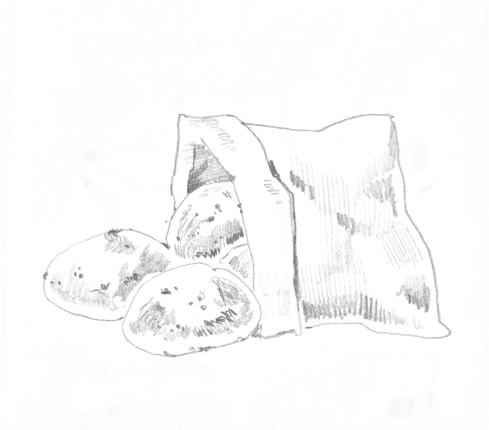
“We love potatoes. But no one loves potatoes as much as my daughter.” My face used to burn when my mom would make that joke. But as a child, I had no shame. Rain or shine, the moment my parents drove off to work in the morning you would find me barefoot in the wet grass, running toward the garden. The wooden fence surrounding it was tall, weathered, and rough—a perfect shield for my secret.
The plant had an earthy smell, and when its once vibrant green leaves faded to yellow and crumbled between my fingers, I knew it was time. Using both hands I’d yank the weak stem up from the ground and give it a good shake. Like a prospector searching for gold, a thrill would run through my body whenever I uncovered potatoes dangling from the stem. Then I would stuff them into my pockets and run back inside to microwave them.
Looking back, I’m truly horrified by this behaviour. And you may wonder why my family never caught on—well, that’s all thanks to Whiskey.
Whiskey was a brown lab who was about as round as a barrel. He ate just about anything. No, seriously. The vacuum cleaner had nothing on him when it came to cleaning up crumbs. But if there was one thing he wouldn’t eat, it was potatoes. However, my mom didn’t know that. So, when I told her that I saw him digging them up from the garden, she stopped letting him out into the backyard. My visits to the garden stopped shortly after that.
***
“We love potatoes, but no one loves potatoes as much as my daughter,” I remember my mom saying at the dinner table. God… she might as well have tossed me up onto a stage and had me dance a jig in my undies.
“It’s only natural,” my dad interjected, offering me a comforting smile, as though that was supposed to help. “Our family is Irish after all.”
“Our family has lived in Canada for over a hundred years.” I snatched the gravy boat, hoping to hide the mashed potatoes that I had scooped onto my plate.
My brother’s eyes lit up, “I know why she likes potatoes.” It was as if he was about to drop the world’s greatest revelation.
“Why’s that?” My mom asked, unaware of what he was up to. My leg bounced up and down. I could barely stand my growing unease.
He began to laugh. “It’s because she’s built like one!” I froze. The words hit me like a slap to the face. Without another word, I pushed back my chair, stood up, and walked away from the table. It would be years before I ate potatoes again.
***
“Why don’t you love potatoes anymore?” My mom asked. I was standing beside her in the kitchen, helping her with dinner. She handed me a few potatoes and asked me to peel them. Are they a fruit or a vegetable? I couldn’t be sure. It didn’t matter, though.
I pulled on my yellow rubber gloves, stretching them all the way up to my elbows. I hated how suffocating the material felt—yet I always wore them. No matter what kind of sponge I used, the dirt never came off completely. I continued to scrub the potatoes under the tap and watched as the water turned brown and swirled down the drain. The thought of eating something so dirty made me want to throw up.
“They’re gross,” I said flatly. The texture, the taste—it all repulsed me now. I can still see my mom’s face in my mind—her eyebrows drawing together in disappointment. She didn’t say anything, but I could tell she didn’t understand. The silence hung between us as I continued scrubbing.
***
Years passed, and I haven’t lived at home since I left for college. But Thanksgiving? That was non-negotiable. Turkey, stuffing, Hawaiian rolls, who could resist? The family had also gotten a little bit bigger after my brother got married. This year, I saw that my mom had left a steaming pile of baked potatoes on the table. My brother picked one up with a fork and placed it in front of his daughter.
“Yucky!” she said, pushing the plate away with a scrunched-up nose.
I couldn’t help but laugh. “Have you ever tried a potato before?” She stared at me with wide eyes. I nearly forgot I was talking to a two-year-old. I reached for one of the potatoes. It burned my fingers, but that didn’t stop me from taking a big bite.
“Delicious,” I said, giving my niece a big thumbs up. The taste was comforting, and I ate the rest of the potato in three more big bites. When I finished, I caught my mom smiling at me.
“See? We love potatoes,” she said, giving my niece a playful wink. “But no one loves potatoes as much as my daughter.”
Originally from Embro, Ontario, Hannah Kirwin moved to Ottawa in 2018. She loves reading, writing and gardening. Currently, she is a first-year Master of International Affairs student studying at the Norman Paterson School of International Affairs at Carleton University. Upon completing her undergraduate degree in English with a concentration in Creative Writing, she decided to submit some of her written works to Sumac Literary Magazine with the hope of getting published.
Apathy is the enemy of Idealism, though Idealism has yet to notice. This lucid hatred may be the only thing Apathy cares about. The two women stand together at a window overlooking the city, where Idealism laughs and ponders the view and gently pokes fun at the people as they scurry to work; Apathy sees only the streaks on the glass and the reflection of her own miserable face and so she refuses to partake in the fun. Idealism finds this behaviour charming and, in her opinion, is indicative of their close friendship, where the silence is golden if you allow it to rest.
Pragmatism only knew the textbook meaning of joy until he met Idealism. Sometimes he doesn’t understand what he’s done to make her laugh so uproariously, but it makes him want to take her in his arms. Pragmatism and Idealism are husband and wife, where the wife wears an eternal megaphone strapped to her chest and her husband rubs her feet at night. Apathy spends evenings like these with bare legs, waiting outside nightclubs and blowing blueberry vape clouds into the faces of strangers. Apathy only sleeps with someone once she knows how she’ll leave them.
Sometimes Pragmatism’s act of physical affection makes Idealism cry and cry. Pragmatism thinks this is because he’s hitting the right pressure points, but Idealism can cry with such ferocity that it frightens him. She tells him the world is so beautiful and so ugly, but the ugliness is something she never sees and can only feel in the bones of her feet. She tells him it walks with her, and she says it can only be her fault if it spreads. Pragmatism knows deeply how wrong she is, but he just stays, silently, and that seems to be enough for Idealism in these long nights. When she emerges from the bedroom in the late morning light, with sleep still in her eyes, she finds him making pancakes. He watches her eat as last night’s admission becomes a breeze; something never meant to stay.
Idealism likes to try new things with her whole heart. She picks up paintbrushes and pens and protest signs. Boxing gloves and running shoes. Dostoyevsky and calculus textbooks; scholarship applications. When Idealism shoots for the moon or somehow manages to murder a cactus, Pragmatism can find her supine on the floor for a month (or three months, or ten).
Pragmatism leans down, strokes her hair, whispers to her: “Take a break and come back stronger.”
When at last she rises, Pragmatism says: “There is a next step here. We will find it together.”
Idealism might resemble Apathy when she can’t pick herself up from the floor, but regardless of appearance, Apathy is not present for Idealism’s hibernation. Apathy is out meditating wherever the world is burning.
Idealism has never been able to shake the feeling that one day she will set out from her front door and start to walk the earth. She will grow taller and taller as she wanders down its hills, skips along its rivers, waves to its mountains, and drinks from its oceans—until one day, she is taller than the tallest trees, unsure whether she is rooting into the earth or reaching for the sky, or both. Idealism knows in her heart that time is a Mobius strip where you only find yourself walking forward. The realization that a shattered glass can never leap back into her hand intact is a puzzle to her: worth a slight furrowed brow but nothing more.
Pragmatism watches Idealism as she plants her feet into her yoga mat and does her asanas. Her dedication to touching the sky—if only in her mind—inspires him to stretch further for his goals, as his goals—once, in plausible reach—are now further away. He allows them to expand slightly, like a balloon his delicate nature will never allow him to pop. Idealism inspires Pragmatism to consider that his dreams will become airborne.
Idealism says to Pragmatism: “I’d never change you.”
Pragmatism says: “You have, and you will again, because you’ve never stopped.”
Pragmatism and Idealism need to kiss on the mouth and roll on the floor together while giving the middle finger to Apathy, who is ignorant of the love people can make to one another; the love an idea can have for another; the idea of love as a balancing act that makes both parties grow taller.
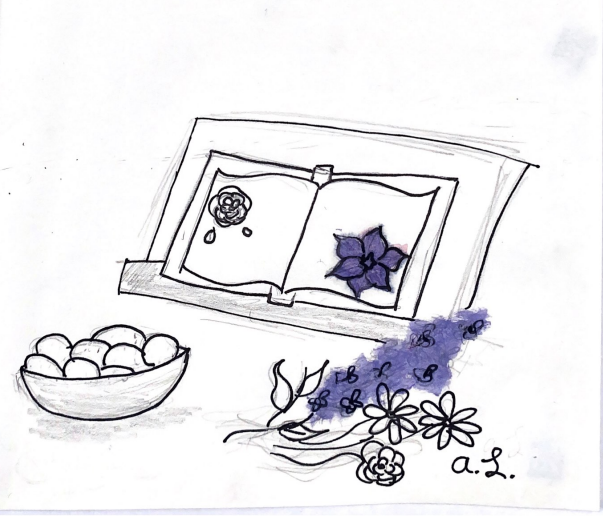
Love is a garden, and if you’re lucky, then sometimes you find potatoes in it. Idealism might marvel in the morning light at the flowering plants and clap her hands; Pragmatism might return in the early afternoon to prune the flowers, so the potatoes will continue to grow steadily beneath the soil. In this perfect world, he presses the purple flowers gently in a book, to preserve them for Idealism to coo and marvel at once more. He presses them into the shape of his heart, and holds steadfast, so he is prepared to give her the gift of summertime when reality becomes dreary or cold or wet—and of course: she may be on the floor again. He would do anything to hear her voice ring out when the silence around them is damp and beckoning.
Right now, Pragmatism and Idealism are eating au gratin in the summertime, holding hands and looking at the trees and clouds from her small, tender balcony.
Nobody cares where Apathy is at all.
Rebecca Dougan has a background in mathematics and engineering, from which she balked at continuing. She now finds herself at Carleton University studying English with a concentration in Creative Writing, where small crumbs of her love for mathematics still turn up in her writing. She has never been happier.
new perspective, renewal can’t imagine mere semantics cool confesses salt of the earth pulling the trigger to heaven
everything changed
really, really persistent you spent weeks looking for that confidence
Lauren Bacall’s a breath of fresh air weightless knot (there’s only one Bacall) the smile coveted
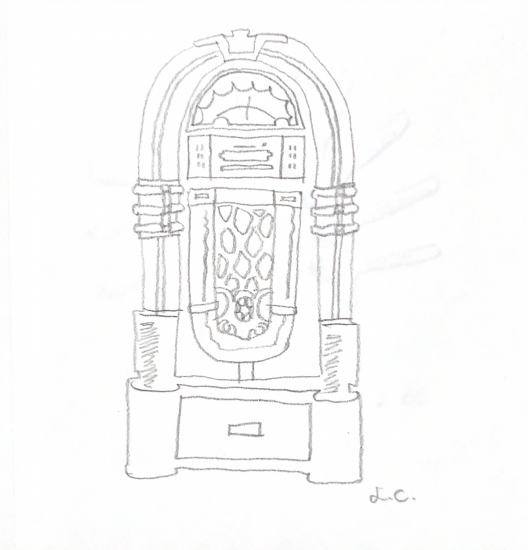
archive after-hours jukebox memories classic portraits fairground at home one last audition
create awakening impossible to imagine winter is coming
half ruminating I had saved his life, now he belongs to the angels Shakespeare is God
rummage through the costume bin mask and unidentified attraction absorbing boys with toys
smart people keep climbing live for no other medium never let it fade down on one knee You always wanted more I do not have a gentle heart
Frances Boyle (she/her) is an Ottawa author of both poetry and fiction. Her latest poetry books are Openwork and Limestone (Frontenac House 2022) and Light-carved Passages (Doubleback Books 2024), a reissue of her debut collection as a free open-access e-book. Her first novel, Skin Hunger, is forthcoming in 2026. Frances was a long-time board member at Arc Poetry Magazine, and currently helps run VERSeFest, Ottawa’s international poetry festival, and the League of Canadian Poets. Apart from admiring the view from Dunton Tower at poetry readings, her main connection to Carleton is a magical poetry class taught by Michelle Desbarats several years ago. Visit www.francesboyle.com and follow @francesboyle19 on Instagram, Blue Sky and elsewhere.
There is a house up for sale on Inglis Court It has red brick and white windows with black shutters The carpet has been deep cleaned, the furniture emptied out I ponder, the things its new owners will not know about
That I walked that rugged driveway, its heat on my small bare feet and drew my name in chalk, with rainbows and blocks for hopscotch How many times I opened that front door to the scent of cod, calling for my grandmother, footsteps shaking porcelain cherubs
That the kitchen had been filled with groaning, swollen bellies stuffed with basted fish, toutons, and corned beef hash How many times I checked the fridge for items I would never find with unsealed margarine containers holding other food inside
That the dining room once contained newspapers and plates with bitten toast and marmalade, and the scent of half-drunk tea How many times that cherry grove antique table had seen my grandfather, me, and a ten-dollar bill snuck underneath
That the bedroom doors creaked along with the shuffle of feet down the hall and across green carpet after a bad night’s dream How many times I lay between my grandparents’ heat and let the pendulum clock tick, tick, tick me to sleep
Now it stands stripped bare, as if we were never there An echoing blank canvas, where hearts used to reside There is a house up for sale on Inglis Court I realize, a house becomes a home by the memories made inside
Kayla Doyle is a writer and paralegal from Toronto, Ontario. She currently works for the Government of Canada and is a third year B.A. Honours English student at Carleton University. She has previously received degrees in both Law and Psychology. Kayla has been writing since she was thirteen years old, and currently lives in Ottawa, Ontario with her husband and son.
I was sitting on my usual armchair facing my therapist, holding a large canvas against my lap.
“Should I show it to you now or after the session?”
“It’s up to you.”
“I’ll show you now, then.”
I turned the canvas around. He gasped.
“Oh, that’s gorgeous!”
I held it up between us so we could both admire it. A large pale yellow moon illuminated a swirling ocean of deep blue spirals. In the distance, the lights of a tiny house on the edge of the sea could be seen. I was proud of this painting. I had been thinking about painting it for him for so long that it was wonderful to finally give it to him and have him enjoy it.
“I wanted to thank you for all your help these last six years. I wrote something on the back.”
I handed him the canvas, and he turned it around.
To Matthew, October 11th, 2023
Thank you for helping me tame the waves and tides of my mind.
Li
—
I wrote my first real poem on the last day of the hospitalization that got me diagnosed with type one bipolar disorder. It was very loose and abstract. I was trying to capture the feeling of the transformation, the incoherent yet divine feeling of becoming ravingly intoxicated on my own faulty dopamine.
you write a saga of hope through the form-filling, the question-answering you chronicle your story on the white walls in purple crayon no washcloth is brave enough to wipe it all down no time is sufficient for everything on your to-do list; its four dimensions
Deep down in my heart and soul, during that first pivotal manic episode, I felt that I was radiating the energy of the all-powerful moon. But that was just a delusion, quickly melted away by an intense dose of antipsychotics.
I scribbled that poem in a hurry as it was time for me to start packing up my room. Dr. Teshima had announced earlier that day that they were discharging me, and I was so elated that I wrote down the news in my journal in giant, colourful letters. My mom brought me that journal on the day I was interned, when she realized that the staff could read anything I wrote down. Providing me with my nearly full notebook would not have been prudent.
During that stay, I spent my days painting because writing anything elaborate was too taxing for my brain, which was bruised and battered after the shock of a psychotic episode. The damage made words difficult to recall, and I wilted from exhaustion after only twenty minutes of supervised strolling on the hospital grounds. I remembered little of what had just happened to me. All I knew was that I had done something—turned into something—unspeakably horrible and that I had nothing to do all day but paint and sleep, paint and sleep. I had gotten quite lucky regarding the ward they put me in; the children’s section was much smaller and more peaceful than the chaotic adult ward. The “classroom” was filled with books and art supplies, so I painted progressively more coherent subjects as I got more lucid.
Although this new identity as a raving lunatic was certainly a surprise, I was never a very mentally healthy teenager. There’s a reason I’ve been in therapy for much longer than I’ve been manic-depressive. My mid-teens were spent making very precise cuts on my right forearm. I felt like I needed to fight for every inch of acceptance from the world when I realized I was nonbinary. Even as a skinny kid, I would starve myself out of hatred for my body and go weeks without feeling a single thing other than apathy.
I mapped this out a few months ago in psychoeducation. The nurse told me to map out my life as a wavy timeline. Peaks were mania and troughs depression. I drew out waves like a heartbeat or a temperamental ocean. I wondered at the utter randomness of the thing. Who could I blame? What did it all mean? This was the question at the heart of my diagnosis. With no one to point to, I often turned inward.
The dietician I was seeing a few months ago once told me that I don’t owe anyone my health. She believed it was completely up to me to care for myself how I saw fit. I told her I disagreed. I do owe the people I love my health. A few skipped medication doses and a few sleepless nights are all that is necessary for me to open up a black hole that devours everyone around me. When I get manic, I am not me. I become a creature of destruction. At first, it’s not so bad: I’m overly energetic and can’t shut up. But at my worst, I have religious delusions of grandeur about being a god. I will promptly empty my bank account, run into traffic, take drugs—anything goes. The last time it happened, I thought I needed to die to save the world.
In the months following my first mania, I battled the ensuing depression by writing down everything that had happened in an ever-expanding Google doc. Every day, I would sit in my pyjamas at my computer and type out my memories of the experience of psychiatric institutionalization. I remembered more of what had happened as time went on. The resulting sixteen-thousand-word mishmash was my first attempt at creative nonfiction. I’ve tried coming back to it a few times to try and make it more polished, but I always find myself unable to get back into the freshly traumatized headspace necessary to keep working on it. It’s like trying to read a depressing book when I’m in a good mood.
I have been fully stable for over a year now. As I’m writing this, it’s been a year, three months, two weeks, and two days since the last time I was in the hospital. I added a reverse countdown to my productivity app around the time of the one-year anniversary. Perhaps it’s unwise to keep track so precisely; I know that resetting the countdown will be soul-crushing if I ever get sick again. But these days, I let myself celebrate my well-being in whatever way I feel.
One of the ways I do this is by trying to absorb helpful media. Sometimes, it takes the form of Sylvia Plath’s poetry. Other times, it involves reading insanely long Harry Potter fanfics (I’m talking at least three hundred thousand words). I recently got entirely absorbed into one about a werewolf. I found the descriptions of his transformations and their aftermaths deeply relatable. The lack of control, the inability to feel hopeful about the future, the agony of each full moon, the feeling like a creature, not a human—all of this resonated with me. But mainly, I related to the waking up. Feeling weak, drained, and foggy, and not having the slightest clue what I did in the last days. Needing to be nursed back to health, only for the whole cycle to happen again. Yeah, sometimes I feel like a moon-drunk monster. I guess the worst part for me is that I don’t even have the moon to blame for it. There is no regularity to my disorder. I can be a perfectly healthy young person for months on end, and then something stressful happens, and I’m back to being an invalid for the next six months.
My body has kept score. In the three years that I’ve been bipolar, I have gained over a hundred pounds. I have shed entire closets of clothes as they slowly stopped fitting me. At first, I was convinced that it was the meds, which have more of a weight-gain side effect the younger you are when they put you on them, but now I’m not so sure. My diagnosis coincided with a lot of other changes in my life. It took a lot of therapy to make me realize that there is no reason to blame myself if it’s all guesswork anyway. I look in the mirror and have a visual reminder that things will never be the same again. But I try to think of myself in terms of softness. I am easy to hold and easy to love. I deserve the stability I now have; I’ve earned it.
It took even more chiropractic appointments to undo the years of stress built up in my back, neck, and jaw. I used to be almost unable to concentrate on conversations with people because of how much the knot in my shoulder blade hurt. Now, I can handle all the hours of sitting with little to no pain. That’s another mark of my progress over the last year. The ocean has quieted, the tides are manageable, and the moon is having mercy.
Li Conde is a third-year social work student with a minor in English. Their work often explores themes of mental illness and healing. It has been published in Sumac, Bywords, and flo. and won second place in the George Johnston Poetry Prize.
flow from the “deep sleep meditation” playlist through the tangled earbuds and slowly drip, medicinal, into my left ear
my eyes have forgotten their desperate micromanaging brain they frantically spasm, left to right unseeing, blurred, a fluttery bird an alert
ticking fingers pinky tensed, grotesquely hooked, trying to get away from its siblings thoughts crowded in their little bone enclosure a million indistinguishable creatures multiplying no room to run
a wolfed down piece of naan, thickly smeared in salted margarine, does tight laps in my stomach along with my evening dose, which was ingested precisely at midnight. they are obligated to swim together a pair of black and white koi fish that keep the balance of my world
i whimpered some soothing words to my imprecise, quivering hands as they dropped the glass of water twice into the filmy sink before bringing the rim to my lips
i prayed to my little pill: small curled up insect, baby tempering pill bug, crawl down my esophagus and burst into a cloud dusting dulling pollen onto the grooves of my brain and the tubes of my heart
Li Conde is a third-year Social Work student with a minor in English. Their work often explores themes of mental illness and healing. It has been published in Sumac, Bywords, and flo. and won second place in the George Johnston Poetry Prize.
The girl is quite ill; that much is obvious. Such a little thing—she couldn’t be more than seven or eight years old. Her dull brown hair hangs limply down to her shoulders, and her face is covered in dirt. Beneath the grime I can tell there’s a slight sheen on her forehead from sweat. Her cherub-like face is red, and she shakes as she stands looking up at me from the mud.
I bend down, meeting her at eye level. “Have you got the pox? Because you’ll be needing a real doctor for that, I’m afraid.”
She shakes her head. “No, Miss. Just the fever.”
Normally, had she contacted a doctor, he would likely use leeches to release her bad blood. But I’m no doctor and I’ve got no leeches, so I suppose my homemade remedies will have to do.
It’s a grey day today—the clouds conceal the sky without texture, as though someone has covered the blue with an old, soot-coloured blanket. The air is heavy with a misty fog that clings to my skin and hair. Surely this means more rain is on the way, though I must admit I’ve had enough of it these last few weeks to last me a lifetime. Things are always quite busy for me this time of year, as winter gives in to the first few rainy weeks of spring. Everything is so wet, and still rather cold. The girl in the alley is the fourth child this week I’ve been asked to treat for fever, and I would hazard a guess that she won’t be the last.
“Wait here,” I murmur. The girl’s eyes follow me as I tread a little further down the alley.
Mr. Clifton, with whom I trade for professional grade remedies, prefers me to use the back door to his shop. Taking the muddier back alleys may be a tad more dangerous, but I have found that it offers the most concealment from prying eyes, as these alleys simply offer back doors and storage spaces for bars and shops down the main street.
The trade-off is quick—some herbs from my garden exchanged for a few proper remedial concoctions that I could not have made myself.
The little girl remains precisely where I left her. Though, as I get closer, mud squelching underfoot, I notice a woman with her now. At first glance I wonder if she is the girl’s mother. She has the same dark brown hair, and she stands with her hand on the child’s shoulder. But as I draw nearer, I can see the hardness in her eyes and the stern shape of her lips. Her hand rests an inch or two from the little girl’s skin, as though she thinks it inappropriate to touch her.
“What can I do for you?” I ask. She’s there for me—that much is obvious—but she doesn’t exactly look ill.
Her throat constricts as she swallows, and her eyes flicker down the alley in the direction of Mr. Clifton’s. Did she see our transaction? Has she come to report me for illegal dealings?
“This child indicated that she has been waiting for you,” she says, finally.
We stare at each other for a long moment, and I get the distinct sense that she is somehow sizing me up.
The little girl releases a dry cough that breaks the silence. She takes the herbs I give her with wide eyes, staring between me and the strange woman she’s found herself sandwiched between.
“Tell your mother to brew a strong tea,” I tell her. “And be sure to drink it all. Every drop.”
She nods as she takes a few steps back from us. I can barely hear her mumbled words of thanks before she turns and runs down the alley, splashing mud up the back of her tattered dress.
“Did you know her?” the woman asks.
I decide I might as well be honest—I’m sure she’s already guessed what I’ve been up to.
“No, I did not.”
“Then why help?”
“What do you suggest? That I stand by and watch a child suffer?” I don’t mean to sound so harsh, but I also don’t want to imagine it. Sitting by a child’s bed. Watching him die and doing nothing to stop it.
She smiles then, and her face looks much less severe that way. She holds her hands up as well in a quick gesture, palms out towards me, as if in apology.
“You practice healing, then?”
Ah. And here it is. The reason for the disruption was not malicious, but desperate. I can hear it in her voice.
“Mostly for the poor. Those who cannot afford a real doctor.”
“What about the people whom the doctor has turned his back on?”
If someone in her life is sick enough that a doctor couldn’t help, I don’t believe there’s anything more I could do for them. Still, I can’t help but picture it. Someone is suffering somewhere. There have been times, plenty of them, when I have had to walk away. Where there was nothing more that could be done. It pains me to leave a house and feel the sorrow follow me home, but I think it may hurt worse if I were to not try at all.
“Alright,” I tell her. “Do you live around here?”
“Yes,’ she says. There are so many emotions in the word. Relief, hope, fear, determination… in a few syllables, in her breath as she sighs, I hear it all.
“Come with me.”
***
Her house, resting on the outskirts of town, looks beautiful in the evening light. Some golden rays escape the grey clouds as we make our way up the drive, caressing the building with their light touch. Something about the air here is different. The way the breeze whispers through the trees out front, and how the white shutters sit with a child’s chalk drawings baking in the sun. It feels like a home.
The woman, Grace, as she has told me, walks heavily up the front steps. They creak as we step up and towards the threshold. Something stops me there, though I can’t entirely describe what it is. A feeling like… like missing a step on the stairs. Like falling. Like something is wrong.
“Oh please, do come in,” Grace beckons. She’s hanging up her shawl on a hook attached to the wood-panelled wall, and before I know it, I have done the same.
“He’s in his room, resting. Come.”
It’s much darker in here; no one has lit the candles yet tonight. Grace takes me through their front room and up the stairs to the second floor. There’s a smell here, something that doesn’t belong. I’ve been around illness before, of course, but I have never experienced this odour. Something sweet, but not pleasantly so. Sickly sweet. Like… rotting.
Grace pushes his door open, and I have the strangest desire to tell her to stop. My hand grips her arm, but it’s too late. There he is, curled up in his bed, wheezing. A little boy.
Perhaps I should have guessed this. In her desperation, I should have known. I should have recognized the desperation of a mother. But maybe I did understand, somehow. As I crossed that threshold, as she opened his door. A part of me must have known.
Sentimentality will get me nowhere here, so I push it away. The images, feelings, of a little boy curled up in bed. A different little boy.
The bedroom is not large. The warmth emanating from the boy’s body fills the small space, otherwise populated only by his bed and a small dresser against the back wall. A window overlooking the backyard has been left open, but the evening breeze does nothing to quell the sickly-sweet smell overpowering the room.
The remedies I’d gathered just this morning from Mr. Clifton rattle in my bag as I put it down. The child’s forehead feels feverish under my hand, but he has no markings on his body. Nothing to suggest smallpox, or any other such illness. But his breathing is laboured, and he’s clutching his stomach, as though it pains him.
“He has fits,” Grace whispers to me. I jump, not having heard her come up behind me.
As his mother describes them to me, I only grow more confused. I’ve never come across an illness with such strange, unbalanced symptoms. He has an intense fever yet does not sweat or shiver. His breathing sounds laboured, yet when I ask him to cough, it is dry and without phlegm. None of his many symptoms align with any illness I have ever seen or treated.
I begin with one of Mr. Clifton’s remedies, knowing it can do more for him than my homemade concoctions. My fingers are steady as I raise it to his lips, which, according to Grace, are dry and cracked no matter how much water he drinks. He swallows the whole bottle as though it has been delivered to him from God himself, and yet his fever will not budge. My hands begin to shake as I pull herbs from my bag, a mixture that has always worked for me before. He breathes in the fumes from this blend, meant to ease his breathing, and yet still struggles to draw breath.
“Do you see now?” Grace asks me from where she kneels beside his head, a hand on his feverish cheek. “The doctor said there was nothing left to be done. Please, Elizabeth, please tell me this is not true. There must be something that can be done…”
It is palpable in her voice now, no longer masked by the hope I brought to her. Fear. Mourning. I know the sound. I know it well enough that my mind shies away from it, cringing away from the void of grief Grace is opening inside herself.
But there is a part of me that does not shy away. I can’t just let a little boy die.
Forcing my sluggish brain into action is difficult. I have no idea what he could possibly be suffering from. Perhaps he’s in the first stages of smallpox and has yet to develop the characteristic lesions. Or maybe it’s simply some sort of flu, a kind I have yet to learn how to treat…
The sun lowers below the horizon as I work fervently, slowly whittling down the resources I brought with me while I treat him as best I can. The moon is high by the time Grace begins to pray.
Dear God, I place my son in your hands and ask that you restore him to health again as your humble servant…
She continues on, and I find myself sitting back for a moment. The moonlight filters into the grim bedroom, its light bathing the boy in white. He lies there, and I watch as he shows no sign of improvement. If anything, his condition has worsened in these late hours. It must be after midnight now.
The witching hour.
Of course. I can’t believe I didn’t think of it until now. Of course. I had heard more and more cases recently, cases of jealous women turned witches, bidding the Devil to enact revenge on their behalf. But this young boy, how could he have wronged someone so greatly as to drive them to that extreme…
Perhaps it wasn’t him. Perhaps it was her.
I feel Grace watching me when I turn to her, though I can barely see her eyes in the dim light.
“This is not a natural illness,” I tell her.
“No,” she says. It’s a statement, not a question.
“You knew.”
She doesn’t answer, but her silence speaks volumes enough for me.
“Why bring me here? Why bring me to heal a boy that cannot be cured?” I’m standing now, though I don’t remember doing so. All I know is that I need to leave—I need to get out of here now. There is evil here, and she’s led me right into it, straight into the stomach of the Devil.
“The doctor wouldn’t help, not when he saw what had happened,” Grace gasps, tears trailing down her face. “I thought perhaps, if someone just tried…” She grabs my hand and I pull away so fast I fall into the doorframe, skinning my elbow on the rough wood. The pain brings everything sharply back into focus. The woman in front of me, so desperate to save her son she is willing to damn me in the process. And the boy behind her, wheezing in his bed. Fragile. Ignorant. Blameless.
It’s a moment before I can speak.
“Who did this?” My voice is rough. Aged. It is a stranger to me.
Grace gives me a name. And I know her. She lives only a few houses down from here, not even to the end of the dirt road.
I don’t remember leaving the house, only dimly realizing the night air is cold against my skin. My feet are too numb to feel the cold mud beneath them, but somewhere inside I keep track of the steps I take. Count the houses as they pass.
It’s more of a shack than a house. For a moment, I can see the witch’s jealousy so clearly in my mind. I see her passing that beautiful home as she makes her way into town. I see her ridiculed for her old age, her bent back, her dirty hands, and I know that the family down the street must have been everything she wanted. Perhaps she thought that if she could not have it, then no one should.
I knock, but there is no immediate answer. There’s a shuffling inside, and a strange noise I can’t quite place. “I know you’re in there!” I call to her. My voice sounds strong, though my hands shake at my side. It must be the cold.
She still doesn’t answer, and all I can think of is the little boy a few houses down and his mother as she prays over his body. I push the door open myself.
There’s a fire burning in the hearth to my left. Her house smells like dirt, perhaps a product of the leaves and soil littered about the floor in the front entryway. There’s a kitchen table to my right, herbs and meat scattered strangely on it, as though I had interrupted the witch during some sort of ritual. One of the chairs by the table has fallen to the ground, and as I follow it with my eyes, I cannot resist the urge to run.
She lays on the floor, crumpled, even smaller in death than she was in life. But it is not her who frightens me—I have seen death before, after all. Looked it in the eyes many times. It is the man who bends over her body, the humanoid mass of shadow, that sends me reeling.
I stumble three steps backwards into the door, whipping around and grappling for the doorknob. But as I stand there, fingers gripping the handle, I hesitate. And that one moment is all he needs.
“A rare occurrence, indeed.”
His voice is a hiss behind me, and I can’t bear to turn to him. It is deep and cold and merciless—the hairs on the back of my neck stand to attention. Then the Devil draws breath, and the rattling in his chest is known to me. A deep, sickly rattle. The familiarity gives me a senseless strength.
When I turn to him, he is no longer just a shadow. He looks very much like a man.
“It is not often that I am caught by surprise.”
“I did not mean…” I cannot get the full sentence out; my voice shakes something awful, but he just smiles. His teeth are rotten. Such a smile is no comfort to me.
“The witch is dead,” he says, gesturing to the body. His hand is slimy, and something that looks like scales glimmers in the firelight. Even in my fear, I understand his meaning. The boy is dead, too, for the Devil would have finished their deal before taking her soul.
“Please,” I beg. My stomach churns as the word comes up, burning my tongue on the way out. His eyes flicker in the firelight, the flames reflected in their depths as he studies me.
“It is not yours, as I understand.”
But I can see mine, my boy, as he looked in his last hours. I can see his laboured breathing, the spots that covered his face burning red in the candlelight. I have watched him suffer for so long; I see it every time I close my eyes. And I feel it, too. That horrible, soul-crushing loss, etched into my heart every minute of the day.
I think he sees this, too. Perhaps it is magic, or simply intuition, but the Devil knows my failure. He revels in it, grinning ear to ear, feeding on my suffering.
Then he speaks.
“There is a way.”
“How?” I rasp. My throat closes in on itself, tightening around the word, as if it somehow already knows how this will end.
“I think I shall have your soul.”
How strange. I don’t even know the boy’s name—Grace never did mention it to me. A nameless boy. Of course, it doesn’t really matter. Not in the end—in this means to an end.
“Yes,” I breathe.
“Take it.”
And he makes his deal.
***
Sunlight pours into the room. It is the first thing I feel—warmth—as the light falls onto my body. The wood is hard under my shoulders, but so solid that it helps to ground me in what I have done. For a moment, eyes closed there on the floor, I do not feel regret, or fear, or loss. I feel at peace.
And then they come in. The men in their boots, shaking the ground as they enter the old witch’s hovel. They pull me up from the floor by my upper arms, yanking me away from my beam of sunlight. I can’t understand. I saved him. I saved that boy. I am not a witch. Yet, as they drag me from the house, I see her standing there. Grace and her son, rosy-cheeked and alive. And she looks at me with such disgust, such fear, I wonder if I have given in to madness.
“Is this her, ma’am?” one of the men asks.
She nods without hesitation.
The sun breaches further over the horizon as they pull me away and down the road. We go past that beautiful house with its white shudders and perfect family, with the son who reminded me so much of my own.
I hope I will see my son again.
I hope God can forgive me.
Please, God. Forgive me.
Madeline Meades is an undergraduate student at Carleton University in her fourth year. She is pursuing a Bachelor of Arts degree in English with a concentration in Creative Writing and a minor in History.
I place my head carefully and a thousand acres of zaatar descend with me. Here there’s a reservoir of soil just for us, tucked away on the other side of your chest.
The beating in my ears coming from a beyond-place of worry catching up to love, somewhere on the other side of your chest, is like footsteps ringing on the ground after a Baloch women’s march.
Carefree, I forget about wudu and drench this earth in everything I refused to shed back home.
I’m a drummer out of practice when I’m wandering the beyond-place, a damp dharkan antheming me home. I sink into strange soils and forget to grow back again.
Precarious unisons, missions, precious unions fill my eyes with the smoke of air strikes and I smell mustard in the wind rising from the other side of your chest.
The rigor trapped in your epidermal craters remains undisturbed while monsoon rages its thunder on my skin.
My soul sings back to the rivers that flood into your arteries and revives lands flattened by giants. I walk back to see echoes of life rooted there: beating, pulsing, pounding, aching on the other side of your chest.
Mekyle Ali Qadir is an aspiring poet of Pakistani origin. He is based in Ottawa and is pursuing his master’s degree in English at Carleton University. A major source of his inspiration is the negotiation of culture and ethnicity he enacts in his life as an immigrant from Pakistan. He cultivated his interests from contrasting and inharmonious arenas, but the common thread running through them has been writing and art, culminating in a poetic voice that echoes diasporic journeys and diverse traditions.
I can hear the distant sputtering of the generator shutting down through the shabby wooden walls of the outhouse. The hazy yellow beam slowly backs away through the peephole as the generator releases its final gasp, plunging the outhouse into a murky purple darkness. The constricting walls loom over me, fully adorned with an eclectic collection of antique trinkets, framed paintings, and taxidermy animal heads. I rise warily and peer out through the slit in the door. Nothing. A thick, rolling overcast obstructs the moon’s pale blue glow, and without the generator’s power, the once vibrant string lights hang limply in dark branches. A howling wind breaks the stillness, rattling the rusty chain lock holding the wood door closed. A flimsy metal chain.
I shrink back and sit down on the wooden ledge. The stale scent of pine lingers from the tub of wood shavings brightly labelled “after-use coverings,” housed beside extra toilet paper rolls. My fingers fidget anxiously, tracing erratic circles through piles of sawdust left on the shelf. I don’t notice when the glass eyes above me begin to wander. A chill whispers on my shoulder as they shift their gaze downwards, their intrigue lingering on my form in cold distaste. Another rush of wind snaps my attention towards the door as the air whistles through the cracks in the brittle walls. I tremble, on edge, my ribcage tense as I take in timid, shallow breaths until the wind dies down again. As the air surrounding the outhouse grows quiet, I allow a shaky sigh to escape my lungs; it seems to echo in the silence, bouncing up and up between the cramped walls. My gaze tracks its path along the dark, splintered wood before it’s captured by the painted eyes of the coyote head mounted above the doorframe. Its eyes fixed on mine with a smirk.
***
“They will respond to you if you howl at them,” she said matter of factly.
“Who, the Coyotes?” I ask, eyes fixed on my marshmallow skewered above the campfire.
“Yeah,” she gestures behind her to the dark trees. “They’re back there somewhere. We used to hear them all the time after dark.” She glances at us around the fire before looking down and taking another sip of her cider.
“We should try it. Someone howl right now,” a playful voice chimes in, jokingly. They rise from the log and throw more fresh mint into the flames. “The bugs are starting to get annoying.” They add, swatting the air around their face dramatically before sitting back down.
“How many different cricket noises can you hear right now?” a quieter voice asks, addressing nobody in particular. I glance at her sprawled out on her back, lying in the grass, her eyes fixed inquisitively on the moon. We all take a moment to ponder the question. I shift my gaze up at the star-dusted sky and focus on the symphony of sounds, trying to decipher the differing chirps and chimes of crickets from the distant croaks of toads and the soft crackles of the campfire.
“Four,” I state plainly, returning my focus to the fire and rotating my marshmallow to reveal the golden crust forming on one side.
“I only hear three,” the first voice challenges with a smirk, taking the last sip of her cider. She shook the can to verify its emptiness before placing it between her palms and, with a clap of her hands, crushed it with a distinct crunch. I watched her throw the crumpled disc aside before reaching for the cooler to produce another can.
“I only heard three at first, too,” the third voice offers graciously. “But listen.” They hold up their hand like a conductor, ready to initiate the orchestra’s performance. We fall silent, considering the three distinct but constant chatters of crickets hiding in the brush, when, briefly, a shrill chime echoes rhythmically overtop of the chorus. “There,” they say, pointing a finger up when the sound rings again, “it’s not as frequent as the others.”
“I don’t understand how you guys are so good at that,” the fourth voice remarks bashfully. She sits up slowly from her place on the grass to warm her hands around the fire. “The forest is so much louder than I’m used to, it all sounds the same to me.” She trails off when a cold white flash dances across the sky from behind us. We turn instinctively to look at the rising storm clouds in the distance as the deep rumble resounds from the sky. A sharp gust of wind rushes through the clearing, strong enough to cause one of the campfire logs to tumble out of place. The fire’s warm glow dampens slightly with the loss.
The third voice chuckles nervously, “It’s not going to rain on us, is it?” they ask, getting up again to tend to the fallen fire.
“It’s not supposed to,” I say, examining my marshmallow for flaws in the dimming light before finally removing it from the stick. “I doubt those clouds will go over us.” I place my melted marshmallow on a graham cracker laced with chocolate and take a bite. “Even if they do, there is no rain in the forecast. We should be fine.”
“That’s good,” they nod. “We have a few more logs left, so we can probably keep this fire going a little longer if you guys are up for it.”
“Oh, I could stay out here all night,” the first voice snickers. “Besides, none of you have howled for the coyotes yet.”
***
The ceiling is leaking. I tilt my head back slowly, eyes glazed over; I watch the droplets protrude from each crack in the wood before collapsing to the outhouse floor in small puddles. A blank flash from outside forces itself through each tiny crack in the wood, illuminating the mounted animals’ sinister silhouettes circling the walls as if cornering their prey. A rumble growls through the vibrating air, causing the trinkets on the walls to sway and clink together with the force. It wasn’t supposed to rain. The coyote sizes me up with a snarl from its vantage point on the wall. It’s too loud now. I close my eyes. The screeching wind, the frantic tinks and clicks of swinging metal and rusted chains, the laboured creaking of the wood structure, all over the top of occasional deep roars of thunder. Four sounds, I breathe and relax the tension in my shoulders. Only four.
A moment of respite, but only a moment. My eyes snap open with the sound of gravel scuffling outside. The movement sounds feral, desperate. My wide eyes meet the hunting stares from above. The scuffling gets louder and louder as those glass eyes size me up. Something hits the door with a slight thud that muffles all the other sounds, and I hear whatever it is fall and settle on the gravel outside the doorframe. With my ears ringing, I stand slowly, creeping hesitantly towards the peephole. The scuffling starts again, but slower, softer, as if the movement is more controlled, a prowl. I recheck the chain lock holding the door shut and lean toward the peephole.
Crunch.
One, distinct, metal crunch.
Hannah Paterson is a third-year English major with a concentration in Creative Writing at Carleton. Throughout her time at school, she has had the pleasure of engaging in several creative writing classes focusing on a wide variety of genres. Over the past year, she has become increasingly interested in writing poetry and was involved in writing, editing, and designing a poetry anthology dedicated to Seamus Heaney with her Celtic Literatures class in 2024.
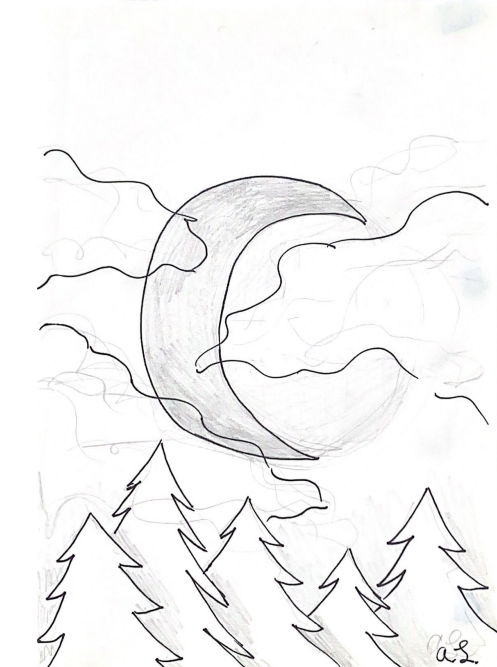
cacophonous cafés, claustrophobic bookshelf crevasses, a modest desk under the waning moon
Don’t disturb them, don’t make any loud noises or sudden moves. The writer is highly irritable
You will know when you’ve spotted a writer They’ll have a bump on their finger, ink on their hands, a hunch to their back, dark rings about the eyes, a pen tangled in their hair, and smudges on their glasses
Beware this curious creature! They’ll speak with passion and write with obsession with their pen they will tear at your chest your heart will bleed onto their inked pages
Annika Keppo is an English student at Carleton University with a concentration in Creative Writing. She favours fantasy and fiction writing, but has realized an interest in poetry which has been published in flo. Literary Magazine. She can be found bookstore hopping around Ottawa, writing in the woods of her hometown in Muskoka, or rooted at her favourite table at the library.