Can one dream while lying awake? This proximity of cloud. Consensus, the end of parenthetical. Draws curtains, threat. This pragmatism: my mother gave birth to it. Melancholy, melancholy. Ask anything you want. What measure, propositions. Withdraw. Jolting, epiphanic effect. This sentence, shadows; these missives on death. Slammed door, silver lining. Declarative: I would have liked to move the earth. Imagine, the desire for mute prose. Liquid. This body or death. This end of text.
rob mclennan’s latest titles are On Beauty: stories (University of Alberta Press, 2024), Snow day (Spuyten Duyvil, 2025) and the forthcoming the book of sentences (University of Calgary Press, 2025). He is currently Artistic Director of VERSeFest: Ottawa’s International Poetry Festival. https://robmclennan.substack.com/
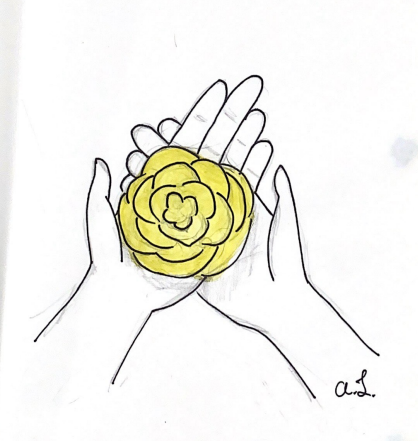
A month ago my boyfriend gave me a carnation I didn’t want it but now I’m stuck with it
At first I thought maybe I wanted it most women love carnations but the more I thought about it the less I wanted it I’m too young and carnations have always scared me
I tell my parents I don’t want it they say that I have to keep it
I tell my sister that I’m scared she says that I’m lucky because she’s always wanted one
I ask my friend if she knows how to dispose of it she says that I should ask a professional
I ask a professional if he can help me he says that it’s against the law
I tell my boyfriend that if men were given carnations they would be able to dispose of them whenever they wanted
I don’t know what to do most carnations are pink but mine is yellow
Originally from Embro, Ontario, Hannah Kirwin moved to Ottawa in 2018. She loves reading, writing and gardening. Currently, she is a first-year Master of International Affairs student studying at the Norman Paterson School of International Affairs at Carleton University. Upon completing her undergraduate degree in English with a concentration in Creative Writing, she decided to submit some of her written works to Sumac Literary Magazine with the hope of getting published.
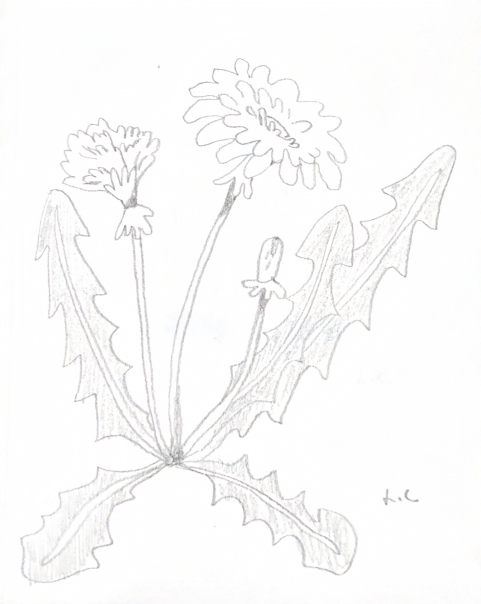
I met you on a Tuesday Lost in the woods And your dandelion-seed touch Set my worried mind free While my body turned to dead weight In a broken lawn chair Ever since that night I’ve been reaching for you Every time I’ve had enough Of twisting and bending
And wrenching myself into knots When the tension starts to feel Like snapping bones I reach for you And when we kiss My muscles unclench So I keep coming back To your foggy embrace Even though I’ve been told You’ll ruin me in the long run I don’t care about the long run When I can’t even walk
Here and now I’m falling Deeper and deeper But you drag me out of the fire And I know this crutch Is crippling me But I keep reaching For a taste of the ecstasy You gave me A moment of leaden-limbed bliss That I’ve been gasping for Ever since
Laura Gillis is a third-year journalism student at Carleton University. Her poem “Seasonal Obsession” won Sumac’s summer postcard contest. She is a writer and storyteller born and raised on Treaty 4 territory.
She was tucked in between a box of junk and a ratty old sweater, only the top of her dull head sticking out amongst the mess.
Head.
Hands.
Chest.
That was all she was. I thought she was the most beautiful thing I ever saw. I took her home and washed her. My crude hands gently scrubbed away the dirt with a warm cloth.
(I could feel her warmth beneath my palms.)
I think my cat is jealous of her.
We spend hours talking.
(She is a great listener).
I show her my favourite books.
(She likes Frankenstein the most).
I dress her up in tank tops and sweaters and dresses.
(Her body never fits them quite right).
She is just like me, in some ways,
Too quiet, with a face that doesn’t move when it’s supposed to.
She stares too much.
I know what it is like to be made of parts that
don’t fit together just right.
Her joints are old and clunky and move slower than they should.
Her face is a blank slate where emotions should be, but I don’t mind.
When I run my fingers along the smooth, bumpy curve of her breast,
I can feel her heart underneath, pounding in rhythm with mine.
Dull and steady.
That is enough.
Today, my mannequin kissed me on the lips.
It happened when I was comparing the size of our hands.
(Mine are far larger than hers, I think she likes that).
She leaned forward and whispered in my ear. I wish I could have heard her. (I’m sorry, I’m sorry).
I cling to her desperately. Lips touch plastic.
Cold.
Dead.
Warm.
Alive.
My teardrops blot on her hardened surface. They roll down her smooth cheeks. Boys don’t cry.
My fingers yearn for her heart, pulsating in my palm. I want to consume her. Let her consume me.
I claw and scrape at my chest, peeling back layers of slippery pink flesh. I destroy myself and build my body up again. She is made of marble, and I am a lump of clay. I am a monstrosity. (Kiss me anyways).
You cling to her. This girl you could be, this woman that she is.
She drew herself out of the rubble and made a spectacle of herself.
She rips out your rib with loving delicatesse, a plastic bone that glows in the dark. (You feel humbled. As if such a beautiful creature could ever be fashioned from the likes of you).
The Garden of Eden is no longer yours.
(Was it ever?)
(can you own what was never made for you?)
I want to live like my mannequin.
Words unsaid lodge in my throat.
Étouffer.
A transitive verb.
In transition.
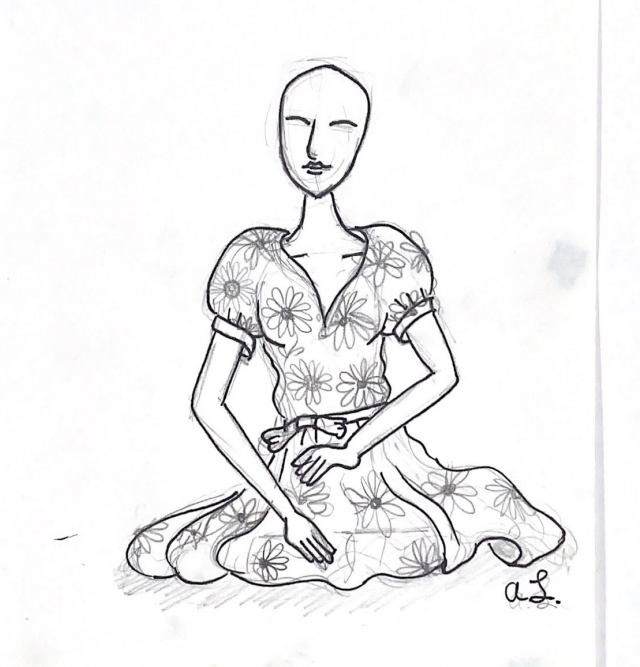
I trace a finger down her spine. Her sunflower dress is crumpled around her waist. The rays of sun streaming through the curtains turn her into a dappled fawn, newly born and clumsy. She is femininity and beauty enveloped in a blank plastic slate.
She is the epitome of womanhood.
(Can I be a real girl, too?)
My mannequin lays beside me as I sleep. I hold her close to my chest. We erupt into licks of white flames, sparking and consuming, shedding the weight of darkness with our light. For the first time, I can breathe.
For the first time, I hear my mannequin whisper.
(You’re breathtaking.)
(There are not enough words to describe what we are.)
(I wish you would let yourself be like me.)
(I know you.)
(I see you.)
(I love you.)
Parker Thomas Paquette is a second-year student at Carleton University, currently enrolled in the Creative Writing Concentration of the English department. When he is not typing away at his desk, Parker spends his time reading, drawing, browsing the shelves of the library, purchasing far too many journals, and creating meaning out of everything. He cites his inspirations as Lisa Hanawalt, Kimya Dawson, T.J. Klune, Lewis Carroll’s Alice’s Adventures in Wonderland, and the “camp” of vintage horror media. Parker acknowledges that Carleton University resides on the traditional, unceded territories of the Algonquin and Anishinaabe nations, and he thanks the caretakers for their continual dedication and kindness to the land.
A Microsoft 365 subscription costs 179 dollarydoos, equating 15 pints per annum. Therefore, you should stay on mine, even though I’m more than antipodean. At this point it’s not even interdependence, you insist, but utilitarianism, yielding warmth and fuzziness. AMP blurbs warn a single 100-word email from GPT-4 wastes 519mL of water in cooling processes. I ask directly. The claim that generating a 100-word email requires 519mL of water is likely an oversimplified calculation based on the environmental cost of training and running LLMs. Assigning a precise water cost to something as small as a 100-word response is highly context-dependent. Water cost varies significantly based on the time of year. “Try again” is a valid prompt. Analysis found that ChatGPT consumes just over one 500mL bottle of water per 100-word request. How to boil an egg. What is the meaning of life? Traditional search engines are gentler. Training GPT-3 is estimated to have used 1 300MWh of electricity, the equivalent of 1.625 million hours of watching Netflix. Almost half of respondents used ChatGPT casually. One application. LLMs are most effectively used for producing text, so use them to assist with writing documents. One heaping teaspoon. Provide as much detail as possible in one prompt to get the most out of it. Please. The result will only be as good as the information initially provided. What I wouldn’t give for one pint, rounded up, spent on a summer night with you.
Feat. ChatGPT-o1 preview and found text from this article.
Ealhwine is the pseudonym of a Carleton alumnus turned AI trainer.
One must imagine, the Kayal that flows to the sea, to be pristine, to be untouched. Allowed to be. but we wade, you wade, not you, you will hear. The sounds of feet, sinking, caressing, mud and glass mud and glass, the lurches of a crowded train, the tardy metal behemoth groaning under its legacy’s weight. But under the bridge that holds the train, lies the water, ebbing with tears, flooding with fears, rising with groans, falling with sores she has grown, never grown, left alone to froth, to foam, to seethe and to churn. She carved into the land with her current, and now she gnaws at the rest since she knows she’s worth more. She has held your dreams, she has held your beliefs, she has held onto your lies and she will no longer be the cradle for the life you keep, the lives you reap, the secrets you tell, the hurt you sow, She will course through the land with dreams of her own, with stories she has written with love that is hers and hers alone. And she will be the Kayal she wants to be
Omar Shaji is a second-year undergraduate English major with a concentration in Creative Writing. He hails from India and is an international student who spent his childhood swimming, running and lighting things on fire. He is entranced by the writing of Ruskin Bond and is currently trying to grapple with the fact that his dislike for otters is not shared by many. Omar Shaji acknowledges that Carleton University rests on the unceded territory of the Anishinaabe – Algonquin Nation. He has published a poem in Sumac before and is grateful for being given the opportunity to submit a piece this year.
Your mossy curls, longer now, hang from tired branches and sway in stagnant wind, distorted. Your decrepit dance in stale air still beckons for dormant woods
The wooded ribcage trembles as you take your greedy breath.
Insatiable roots wrap around my chest drinking my dread, rhythmic thumping beneath the soil. I stumble through the fog down the trail Amygdala, forgotten, spare from familiar footprints left by smaller soles
You found me for the hundredth time.
Hannah Paterson is a third-year English major with a concentration in Creative Writing at Carleton. Throughout her time at school, she has had the pleasure of engaging in several creative writing classes focusing on a wide variety of genres. Over the past year, she has become increasingly interested in writing poetry and was involved in writing, editing, and designing a poetry anthology dedicated to Seamus Heaney with her Celtic Literatures class in 2024.
Upon the steps of the mighty Parthenon, so stood Polias, the high priestess of the Greeks’ golden age: poised tall, with a spear in hand, exuding her wisdom to a crowd of eager Athenians.
“Curiosity is a magnificent tool. The wise Athena favors those who strive for knowledge. For wisdom is given to the Greek man with the will to ask. However, curiosity may grow too powerful, and be used not for the sake of wisdom, but for the greed of lesser men, who grasp and thrash at that which is not theirs. Beware the fury of Athena.”
This is the tragedy of Periagolos, the unwise.
***
Will of wondrous wings wain not. See that vile be caught. Pillar, wall, knot, No hiding can be bought. Deep desires corrode and rot.
Council of three, glean his plea, class and bronze he wish to see. Nay be the answer. Spear to ear, an eager edge, A final thought from the dredge. Nay be the answer. Virgin young, headache stung, She demands his neck be wrung. Nay be the answer.
Three enraged, out of luck. How shall justice be struck? The owl peers through truthful eyes, discern its subject’s lies. Tamper the heart, cut its strides.
Yea be the answer.
Back to life, he scamper. Gone is Periagolos the dancer. Once he was a ranter, No more does he answer.
***
“What is it that lies beyond the coveting columns?” Periagolos asked his instructor, Daskalos, as they make their way to the Parthenon for the priestesses’ sermon.
“To that question, Periagolos, I have no answer. If I did, I would not share. The strength of the gods is not something to be tested, for it can be devastating for a simple Greek such as yourself.”
“Why then can the priestesses, Polias, Plyntrides, and the young virgin Arrephoria enter the temple of Athena so freely, when we cannot?”
“Can’t you see? They have given up their worldly possessions and pleasures in which we so freely indulge. They have given their lives to the gods, so that we may hear their words of wisdom. You cannot have it two ways, or you will be split, and broken.”
“They are not so special. Perhaps I want to speak with Athena.”
“Be careful what you wish for, boy. I will hear no more of this nonsense. We are near the Parthenon. Release this from your mind, or may the Gods do it for you.”
Periagolos walked in shunned silence from his teacher. Their robes draped under the warm watch of Apollo. Sadness took him until his friend, Kakó, appeared.
“Where are we off to?”
Periagolos was first startled, then overjoyed to see his friend. Kakó was always sneaking out of class, indulging in the drink of Dionysus. Kakó brought with him times of pleasure and chaos.
Periagolos and Kakó began dancing in the street at their reunion.
“It’s been many days, where have you been?”
“A blur, I tell you. A blur of nights and of days that leaves me with a gift.”
“A gift? What for?”
“A gift for a gift, my friend. I do not quickly forget your showing me Daskalos’ wine cellar!”
They laughed.
“A chiefly find indeed. Now tell me, what will this gift be?”
Kakó felt around his wavy robes, finally producing a rope tied in an unnatural shape. Periagolos scratched his head.
“I see you are lost.”
“Indeed, tell me what it is you bring me?”
“A knot, a special knot”—Kakó glanced around to ensure no others would hear— “that can hide you from the Gods.”
Periagolos gasped, “How came you by this?”
“A strange occurrence, I tell you. A dark region I found myself in, to unsavory folk. When a man named Dolus beckoned me over. He sold me this knot! Claiming it would shroud me from the scrying of the gods.”
“This sounds like folly.”
“So I thought as well! But, you would not believe all I have gotten away with while it’s been in my possession.” Kakó chuckled, thinking of his devious acts.
“If what you say is true, then I must have it.”
“And what shall you do with it?”
“I will do what no other simple Greek has done before. I will enter the Parthenon.”
Periagolos, with the new confidence of the knot, and the agility of his youth, meandered through the crowd before the steps of the Parthenon. High priestess Polias, her hand, Plyntrides, and the virgin Arrephoria pushed the enormous door open only a crack. They stepped past the shrouding columns and began addressing the Athenians. The Priestess’ voice boomed with divine authority. She preached, relaying what wisdom Athena bestowed upon her.
Periagolos snuck past them, staying along the outer wall. Then up he went, hugging the columns that once kept secrets from him. Now they concealed his person. The door was near, practically within reach. Answers were so close. Periagolos was lost to his great need to know. Holding his breath, and stepping quietly, Periagolos slipped in through the door unnoticed.
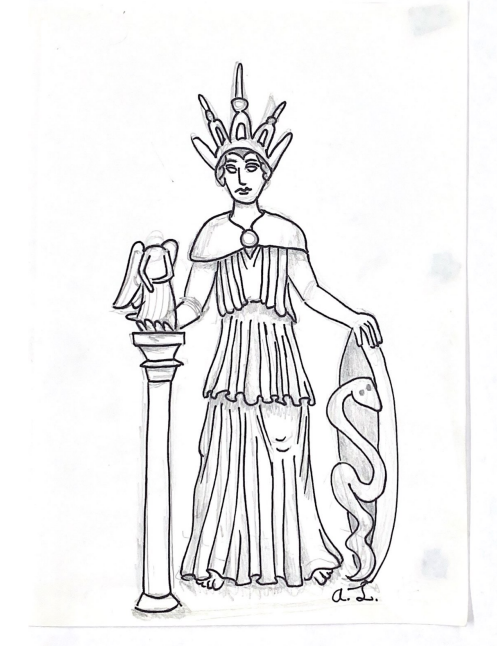
Struck instantly with a new air, Periagolos lost his own. The Parthenon seemed even larger on the inside than it was on the outside. Rich sunlight permeated the ceiling and shone upon the statue of Athena. She held an owl in her right hand and a glimmering spear in her left. The statue was made from more riches than he’d ever known. He could almost hear her thinking, see her breath. An eerie and unexplainable shock came over him. He started towards the statue in a daze.
Distantly, he heard the door close with an echo between the interior columns. Periagolos felt the divine presence intensify. Quickly, he dove out of sight behind a column.
“Athena, our great Goddess of wisdom, we have shared what you wished of us.” Polias led the way through the hall with rhythmic clangs of her spear to the marble.
“You have done well, Polias.” Out came an enthralling voice, directly into the minds of those present, including Periagolos. He felt the immense pressure Zeus must have felt while birthing Athena from his forehead.
“However, a great folly has been made by one Periagolos.”
“What is it you mean, Athena?”
“A knot of deceit, and a devious mind has entered my sacred place.”
Periagolos turned to leave but was immediately met by Polias and her spear. How she appeared there, he did not know. Periagolos fell to the marble and tried to scramble away.
“Who are you to think that you could enter the Parthenon of Athens?”
“I’m sorry, I’m—”
“Answer me!” she bellowed.
“Peri-Periagolos.”
“And why have you entered?” Pyntrides appeared behind Polias with a level and calm demeanor.
“I yearned to see the great halls of Athena. I needed to know what was hidden behind the columns.”
“You knew it was forbidden, yes?”Arrephoria said.
Periagolos nodded. “I do apologize. Please, I beg you, let me go. I will tell none of what I saw this day. Even though it exceeds all the beauty I have known.” Periagolos could not help but steal glances at the colossal statue of Athena.
“Flattery will not save you now.” Polias readied her spear.
“Wait,” Pyntrides interrupted. “A quick death is too little a penalty. He has seen much, I say we gouge his eyes so that he may perceive nothing hereafter.”
Periagolos trembled.
“Indeed,” Polias agreed. “However, what he has seen is nothing to what he has heard. The Goddess herself. Only a chosen few may hear her will. I say we slice his ears so that he may never hear again.” Polias brought the sharp edge of the spear to Periagolos’ head as he started to weep.
“No, no, please! You can’t. I must see and I dearly like to hear, please—” His begging and whining was to the great discomfort of Arrephoria.
“His tongue flaps much, my sisters. Should we not cut it loose so that he may not tell what he’s seen or heard?” Polias agreed pridefully. They reached down his throat and pulled forth his tongue. Periagolos squirmed as tears rolled down his cheeks.
“Enough!” The will of Athena rang clear.
The priestesses ceased promptly.
“Yes, Goddess… what then shall be his punishment if not this?”
“You wish to quell a snake’s appetite to kill, you remove its teeth. The serpent will find a way to choke its victims. You try to stop a bat’s nuisance by taking their vision, louder they will become. You attempt to stop a mouse from eating from your pantry, you take its nose. Still, your rations go missing.”
Periagolos—struck stone-still—watched the massive gold statue of Athena move. In one flutter, she met him. The priestesses knelt in respect as the Goddess’ hand reached out, touching Periagolos’ forehead.
“To level this bush, go not for the leaves, nor branches. One must dig for the very root.” The shined marble reflected the shimmering gold from Athena as it grew in divinity, light dominating the hall.
“I, Athena, Goddess of wisdom,daughter of Zeus, hereby strip you of your curiosity.”
***
Will of wondrous wings wain not Truth, Periagolos there got A deeper power, than previously sought. Now remains a thoughtless face dried with snot.
***
Periagolos found returning to his life more difficult than entering the Parthenon. Kakó came to him with questions galore. But Periagolos no longer wished to speak with him. The topics were utterly boring. It would seem that all things grew mundane, leaving Periagolos’ mind blank.
Daskalos taught, but Periagolos did not listen. His friends drank, danced, and were merry. Still, Periagolos did not budge.
As time went on, his generation of Greeks found love, settled and made legacies. Periagolos did not. He lived alone for his long and dreadful existence until his mind had gone.
He passed into memory, and lesson, so that all may remember the tragedy of Periagolos the unwise.
James Brennan is a relatively new student at Carleton, however, he is not new to the creative act of writing. For about two years now, James has taken on many large—and small—projects in the realm of storytelling, including two novels that are in the editing phase and many short stories, four of which have been electronically published (https://www.story-quilt.com/artist/james-brennan). The genres of these stories vary as does James’s life. He draws inspiration from the things around him and twists them into his tales.
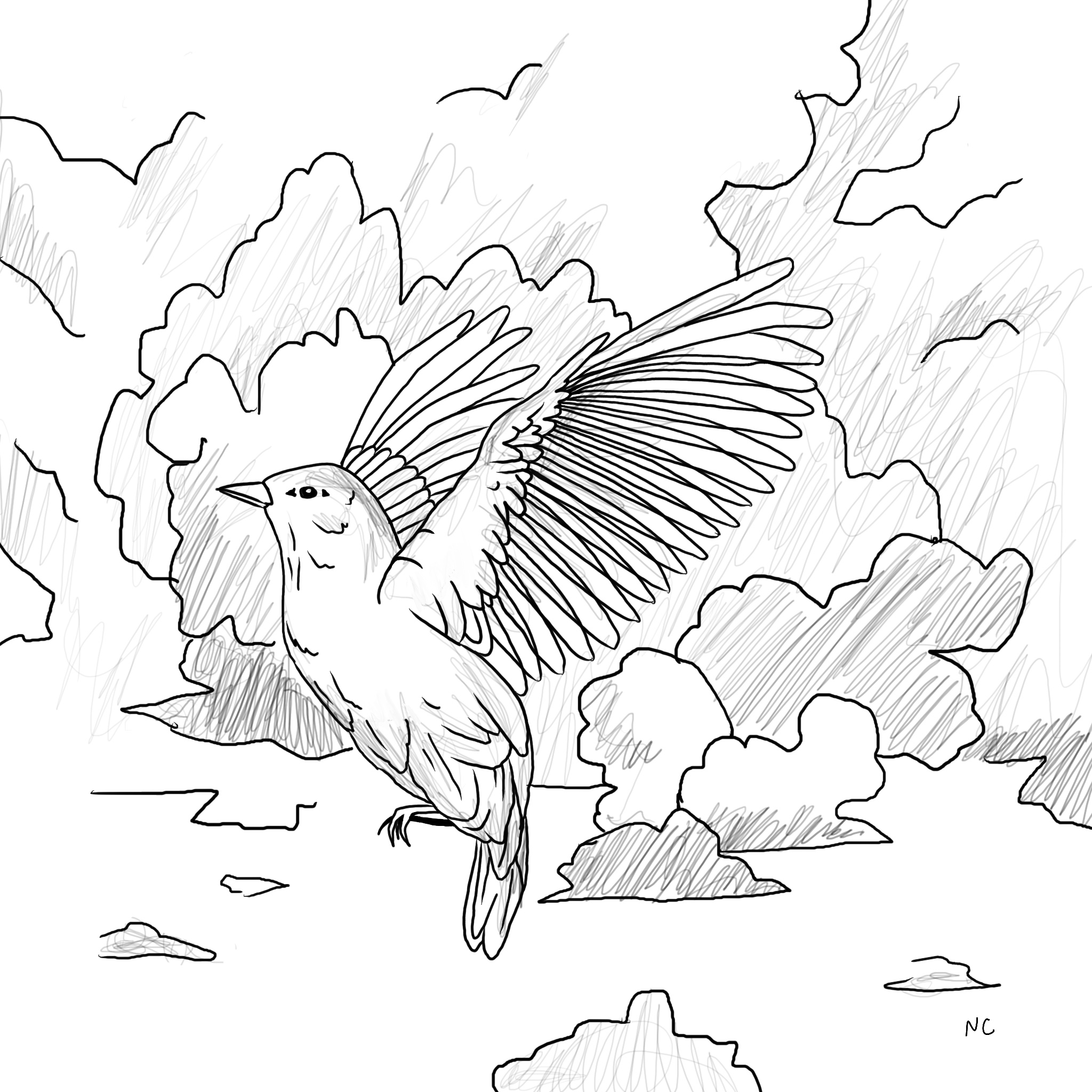
I am walking to the bus stop when I come across a dinner party I was not invited to.
A meeting of like minds, yellowed legs, and ringed bills. They watch me like hunters tracking prey.
Feathers twitch in anticipation of fallen offerings: leftover crumbs of food court fries they will descend upon like blood flies.
A brave one, their leader, perhaps, strolls over to me.
The admiral of an avian army, she puffs her chest to show off many medals.
“Watch me swallow this one,” she says, and the parking lot falls silent.
“Watch me gulp him down whole and hollering, worming his way down my throat.
He is big but my stomach is bigger and God knows I am starving,
for I was made to eat men and beasts and garbage bags
so watch me swallow him down.”
Her underlings laugh their cackling cries, beaks to the sky as though laughing at God Himself.
And then, as quickly as they gathered, they are gone.
Someone tosses an apple core into the bin with a rattling bang and the army takes to the sky, wings fluttering, playing with the wind.
An entire squadron lost in a moment.
I do not see them retreat.
I board the bus.
Percy Hentschel is a first-year Biology and Humanities student at Carleton. He has no previous publication experience, besides a self-published chapbook.
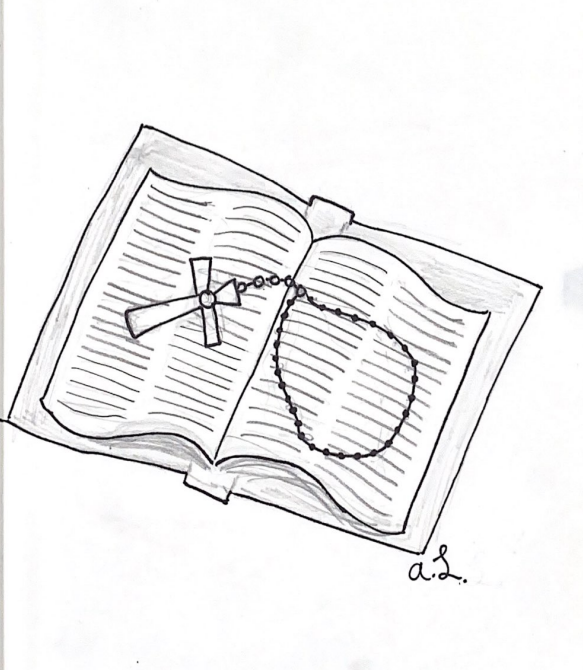
Sometimes, I think there’s a god. Drowsy and with eyes half-lidded, I’ll make my way to the bus stop. Under the glow of a sunrise, I’ll pause to stare at the scripture posted on telephone poles, stapled on top of missing cat posters and ads for cleaning services. In the middle of the empty sidewalk, a few cars drive past, and with their headlights illuminating the dim dawn-soaked paths, I’ll read those holy pamphlets. They speak of sin, and I wonder what my life would be like if I gave in—if I let the garbled religious thoughts dictate more than shame. Can one exist without the other? Everything I do has a layer of blasphemy over it, slick and immovable. It’s that old Catholic guilt. It’s something I never earned. I went to public school, I never read the bible with pious intent, and I never clasped my hands before me with conviction. Still, I had to overcome the hesitation to gasp “Oh my god!” worrying I would upset someone I don’t believe in. Religion settles in the curves of a mold I was forced to grow into. It’s the spot on my dress I can’t scrub out. It’s there whether or not there’s a heaven or hell.
I wonder who I would be if I read the bible and believed it. At age nine with my thumbs coated in black ink, I sat on the floor of my grandma’s bedroom beside her bookshelf with a pocket-sized bible. The font was too small, so I held a magnifying glass up to it. Maybe because of this, I saw something I wasn’t supposed to. I read about how god made light, formed Adam in his image, gave Eve one purpose, and I laughed at the thought of a talking snake. Nothing resonated with me that day. I didn’t feel enlightened or burdened with the weight of my supposed sins. But the things people would say in shows, books, and in school polluted my innate skepticism. Those virtuous preachers made promises of a pearlescent afterlife and the many ways I could be forbidden entry. They told stories of past miscreants that filled me up with an odd sense of déjà vu. They would tell me what I could and could not do, and for some reason, it stuck. I think that’s why I eat apples with a sort of reverence. The first fruit—though, that isn’t true. Earthly delights savoured, scoured, stolen. Teeth sink in, and somehow, I’m Eve again. I don’t think I could resist temptation; every time it stands before me, fresh and bloody red, I reach toward it without hesitation just to know what it felt like way back when.
A man yells “God is dead!” on the sidewalk in front of the mall. People turn and sneer at him, teenagers giggle to one another behind closed fists, parents clasp their children’s ears and tug them closer to their side. Is it sacrilegious to just stand by and watch? If god is dead, did he ever exist at all?
There’s a church on the corner of my street, blue-walled with a white wooden cross standing on the jut of its roof. On Sundays, I see people dressed in their finest walk down that long aisle of steps. Marble-like concrete, consecrated and holy beneath their leather and suede-clad feet. They part like the Red Sea for the priest to walk through the middle, and they bow their hatted heads as he passes. They seem comfortable in the familiar atmosphere. For me, it’s foreign territory. I have only attended church a few times, all when I was little. I would go hand in hand with my grandma, wearing a gold cross around my neck and a long summer dress. I would hold the plush leather-bound book in my hands and let my eyes trace over the words to each of the hymns they sang. I would dig my nails into the squishy cover and watch the indents disappear.
My sister went to Catholic school. We’re half-siblings with an indecisive father and mothers of different beliefs. She would ask her at fourteen and me at ten what Hinduism was, and I would cower because I knew the word but not the meaning. She wore cross earrings and spoke sacrilege in the quiet of our room. She had a communion before she began high school, whereas I’d only ever had a baptism. During the ceremony, I sat on a pew surrounded by family, wearing a floral black dress, and spent the whole of the event trying to understand what was going on.
Every now and then, I feel a sudden tug pull me towards the end of my block, and from the cracked pavement stairs, I’ll glance through the stained-glass windows, hear the choir sing, and imagine the gentle scent of a blown-out flame. Some deep and buried place within me craves a religious life, but I shoo away those incessant, subconscious pleas to go into the church. Still, I imagine. I would wear my Sunday best. I would tip my head before I sat in the pew. I would drink the wine and eat the bread even though I’m not allowed. I would close the curtain in that little box and confess, confess, confess.
What if all I’m dealing with is a fear of missing out? Maybe I want god in the same way I want to attend the party everyone talks about, and relate to the songs on the radio about heartbreak, and wear that new, popular item of clothing sported by those I pass on the street. Maybe I have it right and discovered the purpose of religion (Maybe I’m young and naive and too foolish to contemplate such things).
I have never been a religious person, but I always longed for that gentle cure, that failsafe, that salve of all that is holy and good—the antidote of faith to end the plague of questions. I wanted to feel protected by some all-powerful being, I wanted to have a fate, I wanted to end up somewhere perfect, I wanted answers. I wanted to feel connected, like the choir singers who sway as one, the uniformity of bowed heads and knees rested on those little cushioned benches behind each pew. My grandma is close with the people in her church. She feels better when she goes. She wears a cross around her neck and gets ash and holy water rubbed on her forehead. For a lot of people, religion is light, it is soft and warm—this is what I sought. I never believed in god, but a part of me wanted to.
Recently, I’ve been reading a lot about god. Many gods, all of them, or all of the ones I know about. I read the works of cult leaders, pessimists, and priests. Nietzsche wrote about god being dead.
Should I capitalise god? As an atheist, would it be wrong if I did? Would you care more about what I’m saying if I offered you that morsel of respect? Who wins in this scenario? Is it god himself?
Nietzsche wrote about God being dead. He came up with characters and a plotline full of humour and tragedy and I thought about the gods of Homer and Hesiod. I wondered if the religious writings leftover today were created by people trying to make sense of their world by crafting their own forms of guidance. How do you tell the difference? Was Zarathustra real and Jesus but a myth? Could I walk up to someone and ask them why they believe, and could I get them to try and convince me? Would it be like a vegan asking why a vegetarian eats cheese? Is it just personal preference at the end of the day?
Maybe God died and only exists in the old, the has-been, in memories. Maybe it’s leftover scraps of God that bang on the sky and cause thunder to erupt and clatter down to us. Maybe science is wrong, and the world began with Adam and Eve and that forbidden thing. Maybe if I bite the right fruit, I’ll learn the truth.
I walk down the street, and a man yells, “GOD IS DEAD!”
He yells, “GOD IS DEAD!” And I bow to the priest at the bottom of the steps.
Kaelis Albota Pappert is a first-year student at Carleton working on a degree in English and a minor in Philosophy. Growing up in Ottawa meant Kaelis had access to countless libraries and supportive teachers, all of which helped to cultivate a love for the English language. Her non-fiction essay “I am Writing About God for Some Reason: Ramblings of an Atheist in Crisis” centres around her difficult relationship with organized religion. This is the first literary work Kaelis has submitted for publication.